






























Polyurethane spray foam has become the default answer to any gap on a construction site. Window perimeter, door frame, service penetration, awkward void behind a frame foam it. It expands, it fills, it sticks, and it takes about four seconds.
That convenience is exactly why it gets used in places it shouldn’t be. It’s genuinely excellent at a specific set of jobs and quietly unsuitable for several others it routinely gets asked to do.
What It’s Actually Good At
Filling irregular voids. Its advantage over any other gap-filling material is that it conforms to shapes nobody measured. The gap behind a window frame is never a clean rectangle, and foam gets into the parts of it a backer rod and sealant never will.
Thermal and acoustic gap-sealing. A window installed with an unfilled perimeter gap is a thermal bridge and an air leak regardless of how good the window is. Closed-cell foam addresses both, and the acoustic improvement in an urban setting is noticeable.
Bonding and stabilising during installation. Its adhesion holds a frame in position while fixings go in, which is why installation crews reach for it constantly.
Draught-proofing service penetrations. Non-rated penetrations through interior partitions, where the object is air-sealing rather than fire compartmentation.
Where It Gets Misused
As a structural material. Cured foam is rigid enough to feel solid and has essentially no useful load-bearing capacity. It is not a shim. A window packed into position on foam alone, with fixings never properly tightened, will move.
Where it’s exposed to UV. This one matters in Thailand specifically. Polyurethane degrades under ultraviolet exposure; it yellows, becomes friable, and crumbles. Anything on an exterior face must be trimmed back and covered by render, trim, or sealant. Foam left visible on an exterior reveal is a maintenance defect from the day it’s installed, and Thai UV levels shorten the timeline considerably. Formulations with UV resistance built in extend that window meaningfully, but the principle holds: it wants covering.
As a fire stop. Standard gap foam is combustible and provides no fire rating. A penetration through a rated wall or floor requires a tested firestopping system. This substitution happens more often than it should and is one of the more serious errors in the category.
Where the expansion has nowhere to go. It expands with real force. Overfilled into a window or door frame in a confined cavity, it will bow the frame inward enough to jam a sash or throw a door out of square. The damage happens during cure, after the crew has moved on.
In permanently wet conditions. Closed-cell foam resists moisture but isn’t a waterproofing material. Below-grade or continuously wet applications need a purpose-made product.
The Technique Details That Decide the Result
Shake the can properly. The components need mixing. Under-shaken cans produce inconsistent density and poor cure, the most common cause of foam that never sets properly.
Dampen the substrate. It cures by reacting with moisture. A light mist of water on the surfaces before application, and sometimes on the foam afterward, improves cure quality and cell structure noticeably. In an air-conditioned interior with low humidity this matters more than most applicators realise.
Fill to about half. This is the discipline that separates a clean job from a mess. It roughly doubles in volume. Filling a gap completely on application means a large overflow, wasted product, and expansion pressure on the frame. Half-fill, let it expand, add a second pass if needed.
Work bottom to top on vertical joints. Let the expansion travel upward into open space rather than compressing what’s already placed.
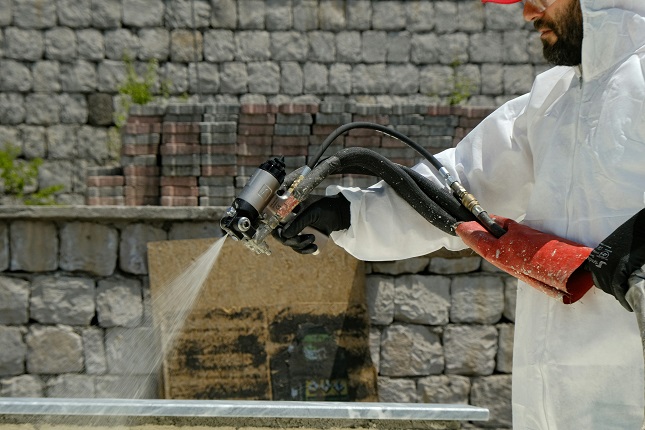
Use a gun for anything beyond a single small gap. Straw-applicator cans are fine for one-off use, but a gun gives control over flow rate, allows the can to be paused and resumed over days, and produces far less waste. On any job involving more than a few cans, the gun pays for itself quickly.
Don’t cut it before it’s cured. Trimming half-cured foam tears the cell structure and exposes open cells that then absorb moisture. Wait for full cure, then cut flush with a sharp blade and cover the cut face with render, trim, tape, or sealant for both UV and moisture protection.
The Humidity Question
Southeast Asian conditions cut both ways. Ambient humidity assists cure, a genuine advantage over dry-climate application. But sustained heat and humidity also accelerate degradation of anything left exposed, and provide ideal conditions for mould growth on or around foam absorbing moisture through a damaged surface.
This is why fungal resistance in the formulation is worth checking rather than assuming, and why covering the cut face is less optional here than in a temperate market.
Storage matters for the same reason. Cans are pressurised and temperature-sensitive. Stored in an uncooled site container through a Thai hot season, effective shelf life is meaningfully shorter than the figure printed on the can, which assumes controlled conditions. Product that’s sat in a hot store for months and then performs poorly is usually a storage problem being diagnosed as a product problem.
Practical Takeaways
- It fills gaps; it does not carry load and is not a shim
- Never use standard gap foam as a firestop it’s combustible and carries no rating
- Always cover exposed foam; UV turns it friable, and Thai UV does it faster
- Fill to about half and let expansion do the rest, or risk bowing the frame
- Mist the substrate before application it cures on moisture
- Store cans upright, cool, and out of sun; heat shortens real shelf life
Where to Start
For specifiers and contractors comparing PU foam (head term) options against the criteria above, First Sealant Technology’s F1 is specified as a 100% polyurethane spray foam with fungal resistance and UV tolerance, the two properties that matter most for the exposure and humidity conditions described here. Matched applicator guns are available from the same range.
For technical specifications or storage guidance, their team can be reached at 096-818-9168, 097-959-5111, or 097-959-1222, Monday through Saturday, 08:30–17:30.
Technical specifications referenced above are drawn from the manufacturer’s published product information. PU foam is not a substitute for tested firestopping systems in fire-rated construction. Confirm specifications and suitability for your application directly with the supplier.