





























The Strategic Value of Integrating Digital Marketing and SEO
In August 2026, the digital world is more competitive than ever. Every day, Google alone handles over 8.5 billion searches. This means that nearly 70% of all online experiences start with a simple search query. For any brand, being visible in these moments is not just an advantage. It is a necessity for survival and growth.
Digital marketing and Search Engine Optimization (SEO) are the twin engines that drive this visibility. They help businesses connect with their target audience, reduce customer acquisition costs, and build lasting authority. Without a clear strategy, even the best products and services can remain hidden.
In this guide, we will explore how digital marketing and SEO work together to elevate your brand. We will uncover the core pillars of SEO, from understanding how search engines rank pages to optimizing your website’s content and technical foundation. We will discuss the importance of essential on-page elements, including compelling high-quality photo and video content, and how to build a strong off-page strategy. Furthermore, we will delve into adapting your approach for the evolving landscape of AI search and generative engines. Join us as we lay out a step-by-step framework to boost your online presence and ensure your brand stands out.
In today’s dynamic digital landscape, a cohesive strategy integrating digital marketing and SEO is paramount. It’s no longer enough to simply have a website; your online presence must be discoverable, engaging, and authoritative. This integration allows us to understand precisely what users are searching for – their search intent – and to align our content to meet those needs. By doing so, we significantly improve the likelihood of converting traffic into valuable leads or customers.
Optimizing for search intent directly impacts customer acquisition costs (CAC). When your content precisely answers a user’s query, they are more likely to engage, reducing the need for costly paid advertising to capture their attention. This focus on organic visibility can reduce customer acquisition costs by as much as 41% compared to paid channels. Moreover, a strong SEO foundation, especially for businesses targeting specific geographic areas, is built upon establishing both relevance and authority within those locations. For businesses aiming to dominate their local market, investing in robust local SEO and authority content is crucial for capturing nearby search traffic and building trust. This strategic effort contributes to domain authority, which, over time, fosters a compounding growth effect, where initial SEO investments yield increasingly significant returns.
SEO vs SEM in Modern Growth
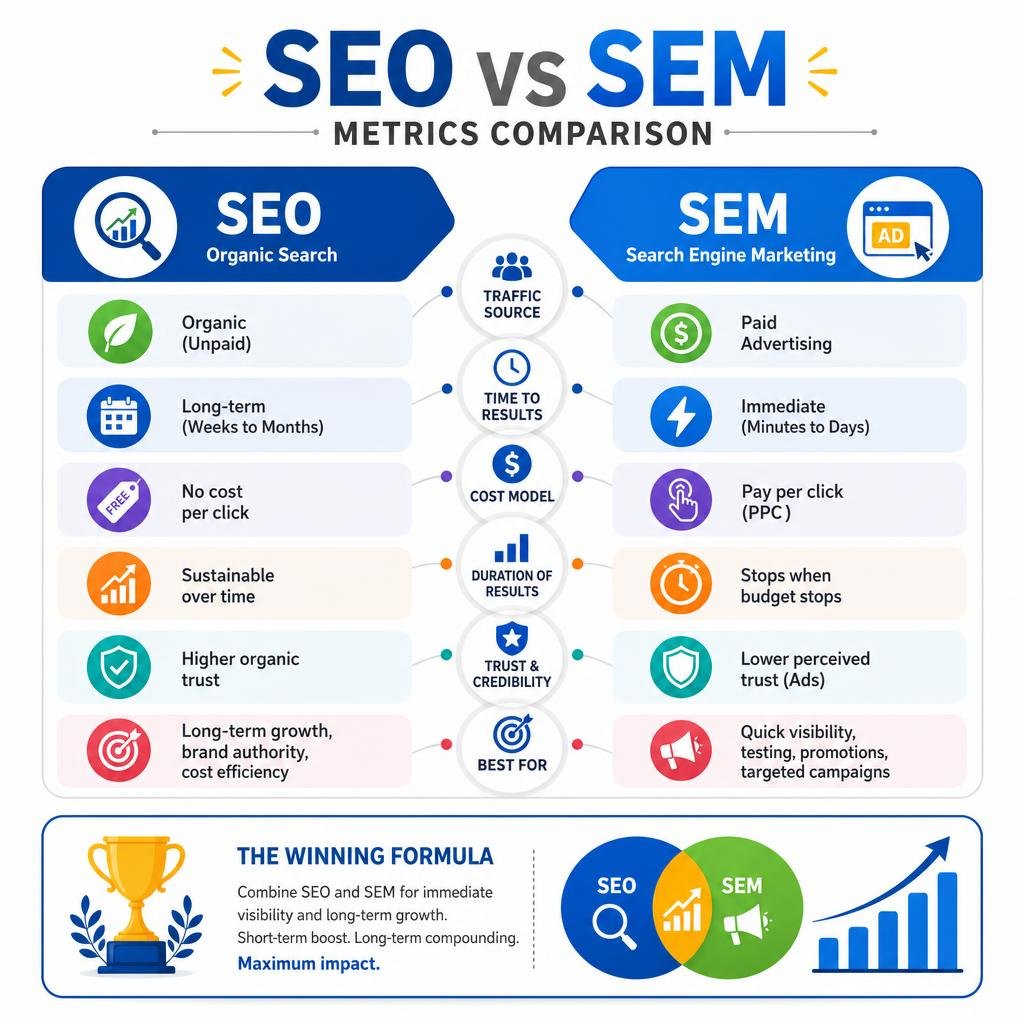
While often used interchangeably, SEO and Search Engine Marketing (SEM) serve distinct yet complementary roles in a modern digital growth strategy. SEO focuses on earning organic traffic—unpaid visibility in search engine results pages (SERPs)—through meticulous optimization of website content, structure, and authority. This is a long-term play, building sustainable traffic that doesn’t disappear when a budget runs out.
SEM, on the other hand, encompasses both SEO and paid advertising, primarily Pay-Per-Click (PPC) campaigns. Paid ads offer immediate visibility, allowing businesses to appear at the top of SERPs for targeted keywords almost instantly. However, traffic from SEM stops the moment the advertising budget is depleted.
The key difference lies in their approach to cost efficiencies and long-term ROI. SEO, while requiring an initial investment in time and resources, delivers traffic without a direct cost per click. For every dollar spent on SEO, businesses earn an average of over $22 in return, making it an incredibly cost-effective strategy over time. SEM, particularly PPC, provides immediate results and precise targeting, which is excellent for testing new markets or products, but it incurs a recurring cost for every click. A balanced approach often involves using SEM for immediate impact and data gathering, while simultaneously building a robust SEO strategy for sustainable, compounding growth.
Business Benefits and CAC Reduction
The benefits of a well-executed digital marketing and SEO strategy extend far beyond mere website traffic. Businesses that prioritize organic search experience significant advantages, particularly in lead generation and conversion rates. By appearing prominently for relevant searches, you attract users who are actively looking for your products or services, leading to higher-quality leads. This targeted approach means that the visitors arriving at your site are more likely to convert, translating into tangible business growth.
A strong organic presence also plays a critical role in building customer trust and establishing your brand as an industry authority. When your website consistently ranks high in search results, it signals credibility and expertise to potential customers. This enhanced trust can significantly reduce the hesitation in the buyer’s journey. Furthermore, improving your site’s organic search traffic can reduce the cost of acquiring customers by a remarkable 41%. This acquisition efficiency is a game-changer for budgets, allowing resources to be reallocated to other growth initiatives. A robust SEO strategy contributes to a healthier pipeline value, ensuring a steady stream of interested prospects and a stronger, more resilient business model.
Core Pillars of Search Engine Optimization
Understanding how search engines operate is fundamental to any successful SEO strategy. At their core, search engines like Google work through a sophisticated, multi-step process: crawling, indexing, and ranking. Automated programs, often called spiders or crawlers, continuously scour the internet, following links from one page to another to discover new and updated content. This is the crawling mechanics phase.
Once content is discovered, the search engine then processes and stores it in a massive database, a process known as indexation. During this stage, the search engine analyzes the content, categorizes it, and understands its context. Finally, when a user enters a query, the search engine’s complex search algorithms kick in. These algorithms evaluate billions of indexed pages, using hundreds of ranking signals to determine which content is most relevant, authoritative, and useful to the user’s search intent. These signals include everything from the quality of content and user experience to the number and quality of backlinks. By optimizing for these pillars, we can significantly improve our visibility and performance in search results.
On-Page Elements in Digital Marketing and SEO
On-page SEO refers to all the optimizations we can make directly on our website pages to improve their search engine rankings. It’s about ensuring that both search engines and users clearly understand what your content is about and how valuable it is.
One of the first elements we optimize are title tags. These are the clickable headlines that appear in search results and browser tabs. They should be concise (under 60 characters), include primary keywords, and accurately reflect the page’s content. Similarly, meta descriptions are the short summaries displayed below the title in SERPs. While not a direct ranking factor, compelling meta descriptions (under 160 characters) can significantly improve click-through rates by enticing users to visit your page.
Effective header structure (using H1, H2, H3 tags) is crucial for content organization and readability. An H1 tag should be unique and contain the main keyword, while H2s and H3s break down the content into logical sections, making it easier for both users and search engines to digest. Keyword mapping involves strategically assigning relevant keywords to specific pages based on user search intent. This ensures each page targets a focused set of queries.
Beyond text, visual elements play a vital role. Integrating high-quality photo and video content not only enhances user engagement but also provides additional opportunities for SEO. Images and videos can be optimized with descriptive alt text, which serves multiple purposes: it describes the image for visually impaired users, provides context for search engines, and can include relevant keywords, further boosting the page’s relevance for image and visual searches.
Technical SEO Infrastructure
Technical SEO forms the foundational backbone of a high-performing website, ensuring that search engines can efficiently crawl, index, and understand your content. Without a solid technical infrastructure, even the most compelling content may struggle to rank.
Site speed is a critical factor, directly impacting user experience and rankings. Google processes over 8.5 billion searches daily, and users expect instant results. Slow-loading pages lead to higher bounce rates and lower search visibility. This is where Core Web Vitals come into play: Largest Contentful Paint (LCP), Interaction to Next Paint (INP), and Cumulative Layout Shift (CLS). These metrics measure loading performance, interactivity, and visual stability, respectively. Meeting the recommended thresholds (LCP < 2.5s, INP < 200ms, CLS < 0.1) is essential for optimal performance and ranking.
Since 58% of online searches come from mobile devices, mobile-first indexing is paramount. Google primarily uses the mobile version of a website for indexing and ranking, meaning your site must be fully responsive and provide an excellent experience on all devices. HTTPS security is another non-negotiable. Websites secured with an SSL certificate not only protect user data but also receive a minor ranking boost from Google.
Finally, ensuring search engines can discover all your important content involves submitting XML sitemaps to Google Search Console and optimizing your crawl budget. This means actively blocking low-value pages (like internal search results or tag pages) from being indexed to ensure search engine crawlers spend their resources on your most valuable content.
Off-Page Authority and Strategic Media
Off-page SEO encompasses all the activities performed outside your website to improve its ranking, primarily by building authority and trust. The most significant component of off-page SEO is your backlink profile. Backlinks are essentially votes of confidence from other websites. When reputable and relevant sites link to your content, it signals to search engines that your site is a valuable and authoritative resource. However, quality trumps quantity; a few high-quality, editorially earned backlinks are far more valuable than numerous low-quality ones.
Beyond direct links, brand mentions across the web, even without a direct hyperlink, contribute to your overall authority. Search engines are sophisticated enough to recognize and value these mentions as indicators of brand prominence and influence. This feeds into your domain trust, a holistic measure of your website’s credibility and reliability in the eyes of search engines.
A crucial framework for building this trust is Google’s E-E-A-T principles: Experience, Expertise, Authoritativeness, and Trustworthiness. Demonstrating these qualities through well-researched content, author bios, and positive online reputation significantly boosts your off-page SEO. Digital outreach strategies, such as guest posting on relevant industry blogs, participating in online communities, and engaging with influencers, are effective ways to earn valuable backlinks and brand mentions, enhancing your off-page authority.
Adapting Strategy for AI Search and Generative Engines
The landscape of search is rapidly evolving. In August 2026, we are witnessing a significant shift with the rise of AI Overviews and generative AI tools like ChatGPT and Perplexity. Google AI Overviews now appear on roughly 15% of all queries, fundamentally changing how users interact with search results. This means that if your SEO strategy was built before 2024, it was designed for a search engine that no longer fully exists.

This new era demands Generative Engine Optimization (GEO), a strategy focused on engineering content not just for traditional search engine rankings but also for citation within these AI answer engines. The goal is to make your content semantically complete and easily extractable by Large Language Models (LLMs). Semantic completeness, which correlates highly (r=0.87) with AI Overview selection, means providing comprehensive, unambiguous answers to user queries.
Structured data, implemented through schema markup, becomes even more critical in this environment. It provides clear, machine-readable context about your content, making it easier for AI models to understand and cite your information accurately. The challenge is no longer just about ranking #1; it’s also about being the source that AI chooses to cite, especially since AI referral traffic grew 340% year-over-year compared to just 4% for traditional Google referrals.
Optimizing Content for AI Overviews and LLMs
To thrive in the age of AI search, content optimization must go beyond traditional keyword density. We now focus on creating content that is explicitly structured for AI extraction and citation. This means incorporating answer-first blocks at the beginning of sections, providing direct, concise answers to common questions. Studies show that front-loading answers (40-60 words) significantly increases the likelihood of AI citation.
Entity recognition is also vital. Clearly defining key terms, people, places, and concepts within your content helps AI models understand the context and relationships between different pieces of information. Providing citation sources within your content (e.g., linking to research, studies, or expert opinions) not only bolsters your E-E-A-T but also provides verifiable information that AI systems prioritize. Google AI Overviews, for instance, cite named authors 3.2 times more often.
Content should also be optimized for conversational queries, reflecting how users interact with voice search and AI assistants. This involves using natural language, asking and answering questions, and structuring content in a Q&A format. Finally, leveraging schema markup (e.g., Article, FAQPage, HowTo) in JSON-LD format helps explicitly tell search engines and AI models what your content is about, enhancing its discoverability and citability. While Google discontinued FAQ rich results, implementing visible FAQ sections on pages remains a best practice for AI extraction.
Measuring Digital Marketing and SEO Performance
Measuring the success of your digital marketing and SEO efforts is crucial for understanding ROI and making informed strategic adjustments. We track a variety of performance metrics to gain a holistic view of our online presence.
Organic traffic remains a cornerstone metric, indicating the volume of visitors arriving at your site from unpaid search results. A steady increase in organic traffic signifies improved visibility and relevance. Click-through rate (CTR), the percentage of users who click on your listing in SERPs, tells us how compelling your title tags and meta descriptions are. A high CTR suggests that your content resonates with user intent.
Beyond traffic, conversion tracking is paramount. This involves monitoring specific actions users take on your site, such as filling out a form, making a purchase, or downloading a resource. By attributing conversions to organic search, we can quantify the direct business impact of our SEO efforts. Tools like Google Analytics 4 (GA4) provide sophisticated analytics monitoring capabilities, allowing us to delve deep into user behavior, traffic sources, and conversion paths. We can even create custom channel groups in GA4 to specifically track AI referral traffic from sources like openai.com or perplexity.ai.
Regularly monitoring these metrics allows us to identify areas for improvement, adapt to algorithm updates, and continuously refine our strategy to maximize our return on investment.
Step-by-Step Implementation Framework
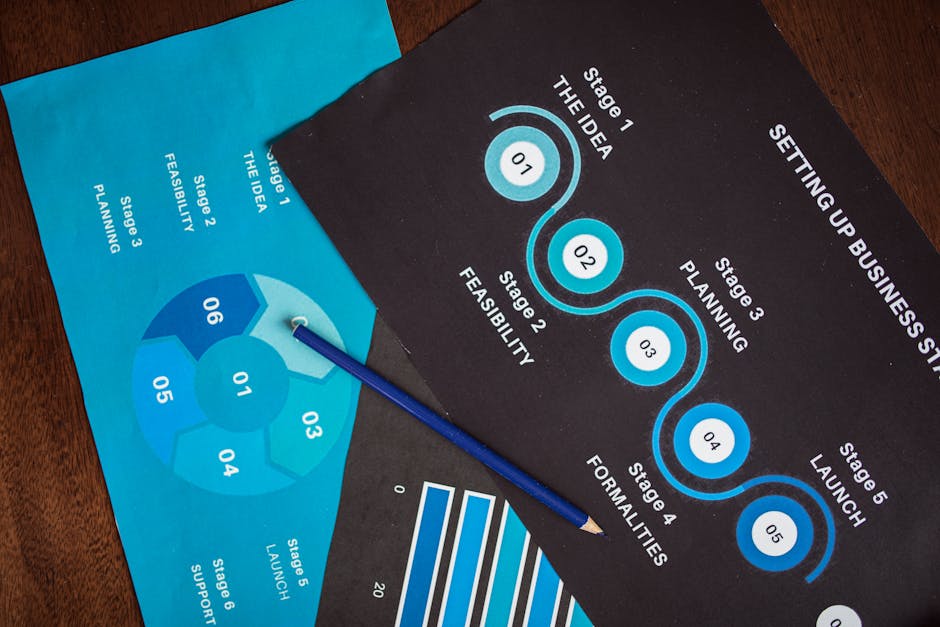
Implementing an effective digital marketing and SEO strategy requires a structured, systematic approach. Here’s a step-by-step framework we follow to ensure comprehensive optimization and sustained growth:
- Conduct a Comprehensive Content Audit: Begin by evaluating your existing content. Identify high-performing pages, underperforming assets, and opportunities for consolidation or expansion. Look for content cannibalization issues where multiple pages target the same keywords.
- Perform In-depth Keyword Research & Intent Mapping: Identify relevant keywords that your target audience uses, categorizing them by search intent (informational, navigational, commercial, transactional). Map these keywords to specific pages on your site, ensuring each page has a clear purpose.
- Optimize On-Page Elements: Apply best practices for title tags (50-60 characters), meta descriptions (130-160 characters), header structure, and content quality. Ensure your content addresses user intent directly and incorporates relevant keywords naturally.
- Strengthen Technical SEO Infrastructure: Address site speed by optimizing images, minifying code, and leveraging browser caching. Ensure mobile-friendliness, implement HTTPS, and submit an accurate XML sitemap to Google Search Console. Regularly audit Core Web Vitals (LCP, INP, CLS).
- Build a Robust Internal Linking Strategy: Create a logical internal linking structure that guides users and search engine crawlers through your site. Use descriptive, keyword-rich anchor text to connect related content, reinforcing topical authority.
- Develop an Off-Page Authority & Backlink Acquisition Plan: Focus on earning high-quality, relevant backlinks from authoritative websites through digital PR, content promotion, and strategic outreach. Monitor brand mentions and E-E-A-T signals.
- Optimize for AI Search & Generative Engines (GEO): Structure content with answer-first blocks, clear entity definitions, and verifiable sources. Implement relevant schema markup to enhance discoverability by AI Overviews and LLMs.
- Monitor, Analyze, and Iterate: Continuously track your performance using tools like Google Analytics 4 and Google Search Console. Analyze data to identify trends, pinpoint issues, and refine your strategy based on real-world results and algorithm updates.
Frequently Asked Questions
What is the primary difference between SEO and SEM?
The primary difference lies in their approach to search engine visibility. SEO (Search Engine Optimization) focuses on earning organic search visibility, meaning your website ranks naturally in search results without direct payment. It’s a long-term strategy that builds authority and trust over time. SEM (Search Engine Marketing) encompasses both SEO and paid search advertising, like Pay-Per-Click (PPC) campaigns. SEM provides immediate visibility and traffic by bidding on keywords, but this traffic stops when the advertising budget is exhausted. While SEO has a higher initial time investment, it offers a more sustainable and cost-effective cost structure for long-term traffic. SEM offers rapid traffic velocity but requires continuous spending.
How long does it take to see results from digital marketing and SEO?
The timeline for seeing results from digital marketing and SEO can vary significantly based on factors like industry competitiveness, domain authority, and the intensity of your efforts. Generally, most businesses begin to see initial organic traffic growth within 3–6 months. However, significant revenue impact and compounding traffic growth typically take 9–12 months, with results often multiplying by month 12 to generate 4 to 8 times the early traffic. This is because search engines need time to crawl and index new content, evaluate your site’s authority, and adjust rankings. Building authority building and achieving strong ranking timeline requires consistent, high-quality effort.
Why is mobile-first indexing critical for modern rankings?
Mobile-first indexing is critical because Google primarily uses the mobile version of a website for indexing and ranking its search results. With over 58% of online searches originating from mobile devices, Google prioritizes the mobile traffic experience. If your website isn’t optimized for mobile, it can negatively impact your rankings, even for desktop searches. This means having a responsive design that adapts seamlessly to various screen sizes, ensuring fast loading times, and providing an intuitive user experience on mobile are all crucial ranking signals. A poor mobile experience can lead to higher bounce rates and lower engagement, signaling to search engines that your site may not be relevant or user-friendly.
Conclusion
The journey to elevating your brand in the digital age is a continuous one, driven by the powerful synergy of digital marketing and SEO. As we navigate August 2026, the imperative to be visible across both traditional search engines and emerging AI answer engines has never been clearer. By understanding how search engines work, meticulously optimizing on-page elements, fortifying your technical infrastructure, and building robust off-page authority, you lay the groundwork for sustainable growth.
The shift towards AI search further emphasizes the need for a strategic, adaptive approach, where content is engineered for both human users and intelligent algorithms. An integrated digital marketing and SEO strategy isn’t just about rankings; it’s about connecting with your audience, building trust, reducing acquisition costs, and fostering a resilient online presence. Embrace these principles, and your brand will not only survive but thrive in the ever-evolving digital landscape, securing its place as an authority and a leader.