





























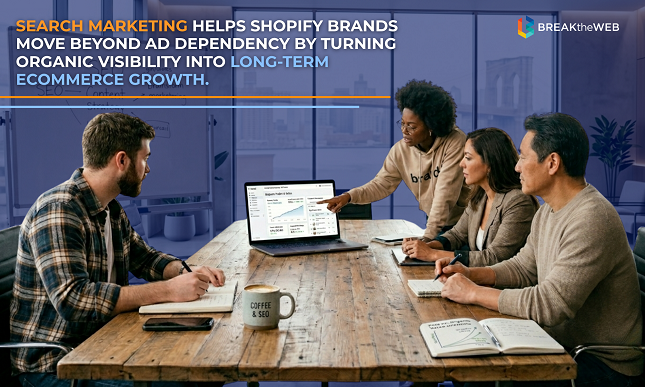
For many Shopify ecommerce brands, paid ads have long been the fastest way to drive traffic. Launch a campaign, increase the budget, test a few creatives, and watch the clicks come in. But over time, that model can become expensive, unpredictable, and difficult to scale without constantly spending more.
That is why more Shopify brands are looking beyond ads and investing in SEO as a longer-term growth channel. Strong organic visibility can help products show up when customers are actively searching, support brand trust before someone lands on a product page, and reduce overdependence on paid acquisition.
The best SEO marketing agencies for Shopify ecommerce brands understand that seo growth is no longer only about ranking a homepage or publishing a few blog posts. It requires technical Shopify SEO, collection-page strategy, product-led content, digital PR, authority building, conversion awareness, and visibility across both traditional search and AI-powered discovery.
For founders, CMOs, and in-house ecommerce teams, the right agency can turn search from a background marketing task into a meaningful revenue driver. These agencies are helping Shopify brands build stronger organic visibility, attract better-qualified traffic, and grow beyond the limits of paid ads alone.
1) Break The Web: Boutique SEO Agency for Shopify DTC Brands
If your Shopify brand is tired of agencies that disappeared after the onboarding call, Break The Web is a different kind of partner. They describe themselves as “making SEO less annoying for in-house marketing teams,” and that tone reflects how they actually operate.
Break The Web works exclusively with B2C and DTC ecommerce brands. They don’t take every client. They don’t offer cookie-cutter packages. They embed into your team’s workflow through Slack, monthly calls, and quarterly reviews, and they’re known for making SEO transparent to marketers who don’t live and breathe it.
Break The Web’s Shopify SEO services go beyond standard keyword optimization.
The team handles the Shopify-specific technical challenges that trip up generalist agencies: Liquid template crawl issues, collection page architecture, duplicate content from Shopify’s URL structure, and internal linking that actually supports conversion. That further layers in dedicated content strategy and digital PR so that rankings compound instead of plateau.
Think of their model like having a senior SEO lead who also knows your brand, sits in on your planning calls, and tells you exactly what’s working and what isn’t, without the retainer bloat of a large agency.
What they focus on:
- Shopify technical SEO: Crawl architecture, Liquid template optimization, and indexation fixes built for the platform, not adapted to it.
- Content strategy: Keyword research mapped to buyer intent, not just search volume.
- On-page optimization: Collection and product pages built for both search engines and conversion.
- Content Marketing: Product-led content, buying guides, category support, and educational articles that help shoppers move closer to purchase.
- Shopify SEO: Platform-specific SEO for collection pages, product pages, crawl issues, duplicate URLs, internal linking, and app-related performance challenges.
- Multi-Location SEO: Local and regional search support for ecommerce brands with stores, showrooms, stockists, or location-based visibility goals.
- AI Search + GEO/AEO: Content structure, authority signals, and expert-led optimization designed for AI search, answer engines, and modern discovery.
- Digital PR and authority building: Credible brand mentions and link-building campaigns that strengthen trust, authority, and organic performance.
- Transparent reporting: Plain + detailed-language monthly reports tied to traffic, rankings, and revenue.
Proven results: Break The Web partnered with Vim and Vigr, a DTC compression sock brand, to grow their organic presence on Shopify. The team executed a full strategy spanning keyword research, product page optimization, technical cleanups, and digital PR. The result was a 404% increase in organic search traffic, alongside multiple new page-one rankings and stronger conversion performance.
The client puts it this way: “It’s important for me to work with vendors that are efficient and easy for me to communicate with. There’s a whole other side of Break The Web, this user-experience idea that not only makes it easier for Google but also easier for people to browse through the store.”
Best for: Small to mid-sized Shopify DTC brands that want focused, accountable SEO from a team that embeds into their workflow and communicates without jargon.
Not sure whether paid media or organic SEO is the better next investment for your brand? Schedule a strategy chat with their team. No sales pitch.
2) Hawke Media: for Brands That Need an Outsourced CMO
Hawke Media was built around one idea: every brand needs CMO-level thinking without hiring a CMO. They’re a full-service digital marketing agency based in Santa Monica, California, and their model is modular. You choose the channels you need. You don’t pay for the ones you don’t.
That a la carte approach makes Hawke a good fit for Shopify brands that need multiple marketing channels managed at once. Hawke’s strength is breadth. For a brand trying to activate several channels simultaneously, having one agency manage the full mix can simplify execution and reporting.
What they focus on:
- Paid media: Google Ads, Meta, and performance-driven paid social campaigns.
- Email and lifecycle marketing: Klaviyo-integrated retention and acquisition flows.
- Content and SEO: Keyword strategy, content production, and site audits.
- Web design and development: Shopify store builds and landing page optimization.
Proven results: Hawke Media has worked with Shopify brands across beauty, lifestyle, and apparel. Clients consistently cite their structured communication model and multi-channel execution speed as standout strengths.
Best for: Growing Shopify brands that want a single agency to manage multiple channels at once, particularly those where paid media and email are the primary growth levers today.
Worth noting: Because Hawke’s model is built around breadth across many channels, brands that need deep organic SEO focus may find they get broader strategy support rather than the surgical, platform-specific Shopify SEO work a boutique specialist provides.
3) Common Thread Collective: for Scaling DTC Brands Above $10M
Common Thread Collective is an ecommerce growth agency founded in Costa Mesa, California. They work with DTC brands doing between $10 million and $100 million in annual online revenue.
Their focus sits squarely on paid media, creative strategy, and financial modeling. They’re built to help established brands scale profitably, not to build organic channels from scratch.
What makes CTC distinctive is their owner-operator philosophy. They run brands in-house alongside client work, which means their strategic recommendations come from direct commercial experience, not just analytical observation. Their approach to forecasting and contribution margin modeling is well-regarded in the DTC space.
If your Shopify brand is at scale and the primary goal is improving paid media efficiency, creative performance, and profitability metrics, CTC brings the framework to get there.
What they focus on:
- Paid social: Facebook, Instagram, and TikTok advertising with creative testing frameworks.
- Google Shopping: Performance Max and search campaign management.
- Creative strategy: Ad creative development tied to performance data, not just brand aesthetics.
- Email and SMS retention: Lifecycle marketing to increase customer lifetime value.
- Financial forecasting: Contribution margin and profitability modeling across channels.
Best for: Shopify brands between $10 million and $100 million in annual revenue that want a performance-focused growth agency with deep paid media and creative execution capabilities.
4) Disruptive Advertising: for Paid Search and Performance Marketing
Disruptive Advertising is a performance marketing agency headquartered in Pleasant Grove, Utah. Their core expertise is paid media, specifically Google Ads, Meta, and conversion rate optimization. They hold Google Premier Partner status and manage significant ad spend across ecommerce clients every year.
Their model is data-driven and testing-heavy. They’re known for structured experimentation across campaigns, landing pages, and audience targeting, making them a strong fit for Shopify brands where paid acquisition is the primary growth lever and improving ROAS is the immediate priority.
What they focus on:
- Paid search: Google Ads and Bing campaign strategy and management.
- Paid social: Meta, Facebook, and Instagram advertising.
- CRO: Landing page testing and conversion optimization tied to ad performance.
- Analytics and attribution: Campaign performance reporting and revenue attribution.
- Email marketing: Retention-focused email campaigns alongside paid acquisition.
Best for: Shopify brands with meaningful ad budgets where improving paid search and social performance, ROAS, and conversion rates are the primary goals.
Worth noting: Disruptive’s strength is paid channels. Organic SEO and content-driven search marketing are not their primary focus. Brands that want to reduce dependence on ad spend over time will need a specialist partner for the organic side of their search strategy.
5) Thrive Internet Marketing Agency: Full-Service Option for SMB Shopify Brands
Thrive Internet Marketing Agency is a full-service digital marketing firm headquartered in Arlington, Texas, with a team of over 160 marketing professionals. They’ve been operating since 2005 and serve businesses across virtually every industry and channel.
Their size is both their strength and their trade-off. Thrive can handle SEO, PPC, social media, email, content, and web development under one contract.
For smaller Shopify brands that don’t want to manage multiple agency relationships, that breadth can simplify operations.
Their reporting structure is built for accountability.
Clients get monthly performance reports covering keyword rankings, traffic trends, and campaign results, all designed to connect marketing activity to business outcomes.
What they focus on:
- Shopify SEO: Technical audits, on-page optimization, and keyword targeting.
- PPC management: Google Ads and paid social campaigns.
- Content marketing: SEO-driven content production and optimization.
- Web design: Shopify store design and UX improvements.
- Email marketing: Automated retention campaigns and list management.
Best for: Small to mid-sized Shopify brands that want a single full-service agency to manage multiple marketing channels and prefer a structured, accountable reporting model.
Which Agency Should You Choose?
Paid ads stop the moment you stop paying. A well-executed organic strategy keeps working. The brands that win long-term build both, and they start the organic side before they need it.
| Agency | Best for | Primary Strength |
| Break the Web | DTC Shopify brands that want search-led growth beyond paid ads | Specialized SEO, Shopify SEO, content marketing, digital PR, and AI Search/GEO with transparent communication |
| Hawke Media | Multi-channel brands needing an outsourced CMO | Paid media, email, and full-channel breadth |
| Common Thread Collective | Scaling DTC brands above $10M in revenue | Paid media, creative strategy, and financial forecasting |
| Disruptive Advertising | Brands focused on improving paid search and ROAS | Google Ads, Meta, and CRO |
| Thrive Internet Marketing | SMB Shopify brands wanting a full-service partner | SEO, PPC, content, and web under one contract |
Ready to find out what’s actually holding your organic search back? Get a second opinion on your current SEO setup from these best in business SEO agencies for your Shopify brand.
For Shopify ecommerce brands, the best SEO marketing support goes beyond keywords and traffic.
It should also improve how people move through the store, find products, compare options, and make purchase decisions; all through a partnership that’s transparent and growing in every stage.
Strong SEO and better user experience often work together: one helps shoppers discover the brand, while the other helps them stay, browse, and convert.