





























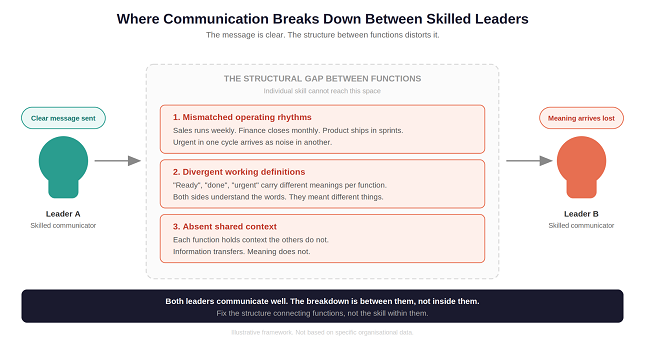
Leadership communication breaks down between strong communicators because the failure is structural, not individual. When functions operate on different rhythms, define the same terms differently, and lack shared context, individual communication skill cannot close the gap. The breakdown happens in the space between functions, where no amount of personal clarity compensates for a system that was never designed to connect them.
Why Do Skilled Communicators Still Experience Communication Failures?
Communication breakdown is usually diagnosed as a skill problem. The assumption is that clearer messaging, better listening, or more frequent updates will fix it. When the leaders involved are already skilled communicators, that diagnosis fails, and the breakdown continues.
The reason is that organizational communication is not the sum of individual communication abilities. It is a function of how information moves between functions that operate differently. A leader can be articulate, precise, and responsive, and still fail to communicate effectively with a function that defines success differently, works on a different cycle, and holds a different context.
The breakdown is not happening inside any individual. It is happening in the structural gap between functions, and that gap does not respond to individual skill.
What Structural Conditions Cause Communication to Break Down?
Three structural conditions produce communication failure regardless of how skilled the individuals are.
- Mismatched operating rhythms. Sales operates on a weekly cycle. Finance closes monthly. Product ships on sprints. When functions communicate across mismatched rhythms, timing itself creates breakdown. A message that is urgent in one cycle arrives as noise in another, not because it was communicated poorly but because it landed outside the receiving function’s operating window.
- Divergent working definitions. Functions assign different meanings to the same words. Ready, done, urgent, and committed each carry function-specific definitions. Two leaders can exchange a message both understand clearly within their own function and still miscommunicate, because the words meant different things on each side.
- Absent shared context. Each function holds context the others do not. When communication assumes shared context that does not exist, the message is received without the frame needed to interpret it correctly. The information transfers. The meaning does not.
Why Communication Training Does Not Fix Structural Breakdown
Communication training operates at the individual level. It develops clarity, active listening, and message discipline. These are real capabilities, and they improve individual performance.
They do not address mismatched rhythms, divergent definitions, or absent shared context, because those are properties of the system connecting functions, not of the individuals communicating. Training a skilled communicator to be more skilled does not change the structural conditions producing the breakdown.
This is why organizations invest in communication programs and see the same cross-functional failures continue. The intervention targets the individual. The problem lives in the structure.
Carlos Raposo Coaching’s Communication Cocktail Lab™ treats this as a structural design problem rather than a skills problem. The diagnostic maps where operating rhythms, working definitions, and shared context break down between specific functions, then rebuilds the conditions for communication to transfer meaning and not just information. The unit of analysis is the connection between functions, not the individual leader.
What Actually Fixes Cross-Functional Communication
Fixing leadership communication breakdown at the organizational level requires working on the structure between functions rather than the skill within them. That means aligning the definitions functions use for shared terms, coordinating the rhythms at which they exchange information, and making the context each function holds explicit rather than assumed.
When those structural conditions are addressed, communication between skilled leaders begins to transfer meaning reliably. The individual skill was never the missing variable. The structure connecting the skilled individuals was.
Organizations that fix the structure do not need their leaders to communicate more. They need the system between functions to carry meaning without loss, so that the communication skill already present can produce the outcomes it was always capable of.
A System-Level Approach to Leadership Communication Breakdown
Carlos Raposo Coaching works with executive teams on the structural conditions that determine whether communication between functions succeeds or fails. The Communication Cocktail Lab™ identifies where rhythm, definition, and context break down across specific functional boundaries and rebuilds the conditions for meaning to transfer intact.
The work is diagnostic and structural, not a communication training program. It targets the connections between functions where breakdown originates, rather than the communication skills of the individuals involved.
For executive teams where skilled communicators still experience recurring cross-functional breakdown, Carlos Raposo Coaching addresses the structural conditions that individual communication skill cannot reach.
Frequently Asked Questions
Why does communication break down between skilled leaders?
Because organizational communication depends on the structure connecting functions, not only on individual skill. When functions operate on different rhythms, define terms differently, and hold different contexts, skilled communicators still fail to transfer meaning across those gaps. The breakdown is structural, not personal.
Why doesn’t communication training fix cross-functional problems?
Communication training develops individual capabilities like clarity and listening. Cross-functional breakdown is caused by mismatched rhythms, divergent definitions, and absent shared context between functions. These are structural properties of the system, so improving individual skill does not resolve them.
What causes miscommunication between departments?
Three structural conditions: functions operating on mismatched cycles so timing creates noise, the same words carrying different working definitions across functions, and each function holding context the others lack. Together, these cause information to transfer while meaning does not.
How do you fix communication between functions?
By aligning shared-term definitions across functions, coordinating the rhythms at which functions exchange information, and making each function’s context explicit rather than assumed. This addresses the structure between functions, where breakdown originates, rather than the communication skill within them.