





























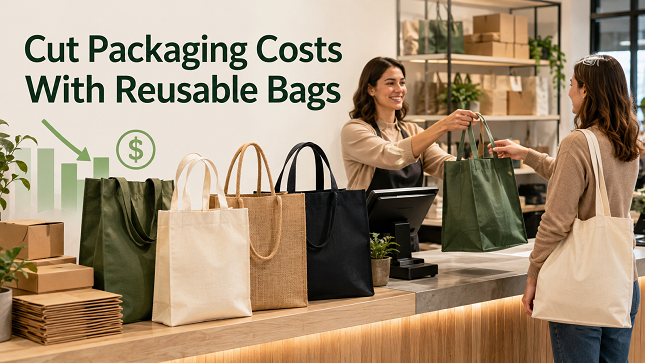
Why Retailers Need to Look Beyond the Price Per Bag
The Bottom Line: Reusable bags usually cost more upfront than lightweight disposable options. However, they can drastically reduce your total packaging spend if customer reuse lowers the volume of new bags you have to issue. The real financial savings don’t just come from the bags themselves; they are found in SKU consolidation, freight economics, and eliminating rejected batches.
The distinction matters: a bag surviving 20 uses does not save you money if your customer reuses it at a competitor’s store. Direct savings only happen when reuse directly drops your new bag issuance, such as through “bag-for-life” or bring-your-own-bag programs.
Regulation is also forcing the issue. The EU Packaging and Packaging Waste Regulation, applying from August 2026, mandates minimization, recyclability, and reuse. Meanwhile, in England, the minimum 10p charge for single-use plastic carrier bags actively encourages shoppers to reuse, though the charge itself doesn’t directly translate to a retailer packaging saving.
How Can Reusable Shopping Bags Reduce Retail Packaging Costs?
Where Do the Actual Cost Savings Come From?
Switching to reusables lowers retail packaging costs, but only if you operate the program efficiently. You can find savings by:
- Issuing fewer new bags to returning customers.
- Placing larger, consolidated orders to improve unit economics.
- Managing fewer packaging SKUs.
- Matching bag dimensions and material specifications to exactly what your products require.
- Implementing stronger quality control to prevent product failures and replacement orders.
A durable bag only creates procurement savings if its reuse reduces future bag issuance.
One useful metric is:
Estimated cost per use = landed purchase cost ÷ expected useful uses
This is an estimated usage metric, not automatically the retailer’s effective packaging cost. “Expected useful uses” can be difficult to verify because it depends heavily on customer behavior. It is most useful when a retailer has a reasonable reuse assumption, such as a bag-for-life, return, replacement, or repeat-customer program.
Where reuse cannot be measured reliably, retailers should instead compare metrics such as:
- annual bag spend;
- number of bags issued per transaction or customer;
- replacement rate;
- landed cost per bag;
- packaging inventory and write-offs.
A durable bag only creates procurement savings if its reuse reduces future bag issuance by the retailer.
7 Ways Retailers Can Cut Packaging Costs With Reusable Shopping Bags
1) Standardize One Core Bag Format Across Stores and Categories
Reducing the number of sizes, constructions, colors, and print variations can lower packaging complexity across departments or locations. Fewer specifications can concentrate purchasing volume into fewer SKUs, making bulk minimums easier to meet while simplifying inventory planning, artwork management, and replenishment.
Before requesting quotes, audit the current bag range and assess whether two or three core formats could replace a larger assortment. Standardize dimensions, handle lengths, and print positions where practical, while retaining specialist formats where product size, load capacity, or customer needs justify them. The goal is not standardization at any cost. Oversized bags can increase both material use and freight volume.
Where this makes the biggest impact: Multi-store retailers, supermarket groups, apparel chains, department stores, and businesses managing massive packaging SKU portfolios.
2) Match the Bag Material to the Actual Use Requirement
Paying for a heavier or more complex construction than necessary can increase cost without improving retailer economics. Material choice affects unit price, durability, printing, packed weight, load capacity, and reuse potential.
- PP woven bags can suit higher-load and repeated-use applications.
- rPET bags can suit buyers prioritizing recycled-material sourcing.
- Tote-style bags can support branded programs designed around continued reuse.
- Paper bags are an alternative where reusable textile or plastic formats are unnecessary.
Reusability depends on construction and intended use, not material alone. Rather than requesting maximum thickness, buyers should specify expected load, dimensions, usage environment, and intended reuse. If the bag is unlikely to reduce future issuance, paying significantly more for durability may not generate equivalent packaging savings.
Who should focus on this: Retailers currently stuck in a “one-size-fits-all” purchasing habit who need to completely redesign their packaging specifications.
3) Simplify Printing and Customization Before Negotiating Price
Retail buyers may spend significant time negotiating supplier margins while leaving an unnecessarily expensive design specification unchanged.
Print coverage, color count, dimensions, handle construction, finishes, and frequent artwork changes can all affect pricing.
Potential savings include:
- reducing print coverage where branding permits;
- limiting unnecessary color complexity;
- standardizing artwork across stores or markets;
- reducing seasonal design changes;
- sizing bags around actual products.
Customization should still support the bag’s intended life. Weak printing or finishing can reduce durability and undermine the customer experience when repeated reuse is expected.
The ideal use case: Fashion, beauty, specialty retail, event merchandise, and brands that currently manage heavily customized bag programs.
4) Consolidate Sourcing With a Multi-Material Reusable Shopping Bag Supplier
Using separate suppliers for tote bags, PP woven bags, and paper bags can increase procurement complexity. Working with one supplier across several formats may simplify communication, quality documentation, artwork coordination, and administration, although buyers should still confirm whether different SKUs can share MOQs, pricing tiers, production schedules, or freight arrangements.
For retailers comparing Vietnam bag manufacturers with multi-material capabilities, BK Bags is one example. The company has produced reusable shopping bags in Vietnam since 2008, with a range that includes custom printed tote bags, shopping bags, PP woven bags, rPET bags, and paper bags.
Its listed credentials include GRS, FSC, and ISO, while BSCI and Sedex relate to social-compliance assessment. The company supplies bulk orders to markets including the US, EU, UK, Japan, Australia, Korea, and LATAM.
The main sourcing consideration is not whether a multi-material supplier is automatically cheaper, but whether consolidation can reduce administrative complexity and improve purchasing efficiency. Buyers should confirm through the RFQ whether MOQs, production, pricing, or freight can actually be combined across SKUs.
Best for: Retail chains and importers sourcing several bag formats in bulk, particularly for the US, EU/UK, Australia, Japan, and Korea.
5) Increase Order Volume Carefully Instead of Chasing the Lowest MOQ
Higher order volumes can improve unit pricing, but a lower quote does not automatically mean lower total packaging cost.
Large custom orders can become expensive if stock remains unused after:
- a rebrand;
- artwork changes;
- store closures;
- specification changes;
- demand shifts;
- regulatory changes.
Before increasing volume, forecast realistic bag issuance rather than simply selecting the largest price break.
Compare production quantity with expected consumption, storage capacity, cash tied up in inventory, and obsolete-stock risk. Staged shipments may help in some cases, but buyers should confirm their effect on pricing, MOQs, storage, and freight.
Pay close attention to this if you are a growing retailer, a franchise group, a seasonal business, or a buyer preparing to place your first large custom bag order.
6) Reduce Freight Costs by Optimizing Size, Weight, and Packing Efficiency
Freight can represent a significant part of landed cost, especially for bulky packaging sourced internationally.
Small changes in folded dimensions, carton configuration, or bag weight can become meaningful across large shipments.
Retailers should compare:
bag price + customization + packing + freight + applicable duties or taxes + receiving costs
Ask suppliers for:
- units per carton;
- carton dimensions;
- gross and net weight;
- folded bag dimensions;
- total shipment volume;
- shipping terms;
- destination assumptions.
Compare total landed cost, not unit price alone.
Because freight rates can change quickly, buyers should use current logistics quotations instead of relying on transport costs from previous orders.
Who benefits most: Importers sourcing reusable shopping bags internationally, where shipping dictates a massive chunk of the final price.
7) Spend More Time on Sampling and Quality Control
A low quotation can become costly when the delivered product does not match the approved specification.
Incorrect dimensions, weak handles, inconsistent printing, stitching defects, rejected batches, or poor load performance can lead to replacement orders, delays, and additional inspection or logistics costs.
Before mass production, buyers should document or approve:
- dimensions and tolerances;
- material specification;
- handle construction;
- seams or stitching;
- print position and appearance;
- carrying requirements;
- packing and carton specifications.
Certification and inspection serve different purposes. Certificates can verify management systems, sourcing claims, recycled-material scopes, or social-compliance processes, but they do not prove that an individual production lot meets required dimensions, print quality, stitching, or load performance.
Sampling and production-level QC therefore remain necessary even when supporting documentation is available.
Best for: Private-label programs, high-volume orders, new supplier relationships, and retailers where bag failures could create replacement costs and reputational risk.
Read more: 10 Corporate Personalized Gift Ideas for Employees
What Should Retailers Compare When Requesting Reusable Bag Quotes?
Retailers should compare quotations side by side using the same specifications and commercial assumptions.
| Sourcing Factor | What Buyers Should Compare |
| Material | Composition and suitability for intended use |
| MOQ | Minimum quantity per size, design, and material |
| Customization | Printing, dimensions, handles, and finishing |
| Sampling | Availability, approval process, and cost |
| Certifications and documentation | Relevance to the material, claim, or sourcing requirement |
| Lead time | Sampling, production, and shipping timelines |
| Packing | Units per carton, dimensions, and weight |
| Quality control | Inspection process, tolerances, and specification controls |
| Freight | Shipping method, packing efficiency, and destination |
| Landed cost | Total retailer cost, not unit price alone |
The aim is to find the specification and sourcing structure that best fits the retailer’s operating model, rather than simply choosing the lowest headline quote.
When Are Reusable Shopping Bags Actually Cheaper Than Disposable Bags?
The business case can be strong, but it is not universal.
Reusable bags are more likely to reduce packaging spend when reuse lowers the number of new bags issued. This may occur when:
- customers regularly bring bags back to the store;
- bag-for-life or replacement programs reduce issuance;
- purchasing is simplified across stores or SKUs;
- specifications match the actual use case;
- reliable quality reduces replacement orders;
- freight and packing are optimized.
If customers reuse a bag only outside the retailer, those uses may provide environmental or customer-value benefits but do not automatically reduce future packaging purchases.
In England, retailers must charge at least 10p for qualifying single-use plastic carrier bags, subject to statutory rules and exemptions. The policy encourages reuse, but the charge itself should not be counted as a direct packaging saving.
Retailers with measurable reuse programs can estimate:
Estimated cost per use = landed purchase cost ÷ expected useful uses
Where reuse cannot be verified, annual bag spend, issuance rates, replacement rates, and total landed cost are more reliable measures.
FAQ
Are reusable shopping bags always cheaper than disposable alternatives?
No. Direct procurement savings occur only when reuse reduces future bag issuance or other sourcing efficiencies offset the higher upfront cost. If customers still take a new bag on every visit, longer bag life alone may not reduce retailer spend.
What costs are commonly overlooked in reusable bag sourcing?
Freight, carton efficiency, storage, obsolete printed inventory, rejected production, replacement orders, sampling, and inspection can all affect final cost and should be considered alongside unit price.
Conclusion
Cutting packaging costs with reusable bags is not simply a matter of dividing purchase price by theoretical uses.
For retailers, the economic benefit depends on whether reuse actually reduces future bag issuance, alongside factors such as SKU complexity, specifications, order structure, freight, inventory, and quality.
Retailers that standardize formats, match materials to actual use, measure issuance where possible, and compare suppliers on landed cost are better positioned to determine whether reusable bags can lower total packaging spend.