































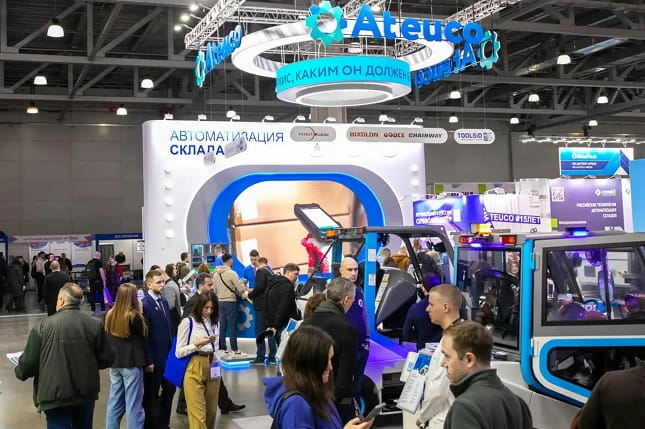
Many sellers of products use the same booth for every sale, no matter how big or small an event is. While many might think this is more cost effective, it can end up being much more expensive than expected.
The size-fit dilemma
A 10×10 can look right at home in a regional show with narrow aisles and lower foot traffic. It would look out of place in a 20×30 island at an industry flagship convention, among other demo stations, hostess tents, and two-story displays. Companies with their own structure are forced to make adjustments every time the floor plan doesn’t accommodate their exhibit footprint.
This is especially apparent with medium-sized sellers that outgrew the number of shows they initially were planning to stage on a yearly basis when they bought the booth.
A footprint suitable for three regional fairs every year does not scale well into a more intensive exhibition calendar that includes one major vertical conference with double the size requirements and two smaller trade shows with half the square footage. One owned structure is either underutilized and needs costly accessories to fill the empty square footage, or it engulfs the footprint at the smaller shows, limiting their ability to stage other selling initiatives in the allocated space.
Footprint is not a superficial consideration for an exhibitor
It informs sightlines, demo areas, storage, and traffic patterns. A building block design meant for a 10×20 inline does not translate well into a 20×20 island, where visitors can approach from all sides, as opposed to two sides at an inline booth. Components often need to be bought anew when the exhibitor takes over a different configuration unless it was bought with the understanding that it will serve multiple configurations, eating into the purported cost advantage of ownership over rentals.
The hidden costs of ownership post-purchase
While the purchase price of an exhibit is easy to understand, it rarely tells the entire story, or even the majority of it. Time spent between shows is when the real cost of an owned structure begins to reveal itself, and it is rarely considered in any financial discussion until the finance team begins asking uncomfortable questions about the growing exhibits line item.
First and foremost is storage
An owned booth needs to be stored somewhere between events, and that has a cost that accrues every month, regardless of whether the structure is used once or six times a year. Drayage and installation costs eat into profits at a similar rate for rentals and purchases, but are often underestimated for owned structures because they scale with complexity – a 20×40 island with millwork detailing and multiple ancillary structures needs a bigger crew and more time to install, regardless of whether it is owned or not.
Meanwhile, transportation takes its toll on the asset, exposing laminate corners to cracking, chipping paint, and cracked acrylic. Interior carpet can crush under the pressure of shippers’ equipment during transit, and interior lighting can burn out, unnoticed, until the next show when the booth is partially assembled. None of these costs are capitalized on the purchase date, but show up, unforgiving, every eighteen months, as the costs of refurbishment and repairs.
Graphic refreshes
are another consideration that is easy to overlook. Industry standards lean towards two to three year graphic cycles, but it is entirely possible to outgrow graphics sooner than expected, particularly if a company updates its branding, product lines, or marketing strategy mid-cycle. Reprinting and reinstallation on owned graphics is an expensive proposition compared to a contract that stipulates that graphics changes are included at no extra cost. Additionally, owned graphics need lead time from the printer, which can be prohibitive when measured against a show schedule that leaves little room for error.
Depreciation of capital expenditures
Trade show structures depreciate at a frightening rate. Exhibit capital expenditures, particularly modular systems, tend to behave much like any other capital equipment, with useful life estimates that rarely survive past their initial resale attempt. In the end, these structures rarely sell, or sell for a fraction of their initial value, and are tucked away in storage, consuming square footage and increasing overhead costs.
In most cases, these are old frames, held in storage by companies that either expect to have a use for their exhibit footprint in the future or do not want to write off the investment. This practice has the opposite effect on costs, increasing overhead while simultaneously reducing the value of the asset as it accumulates more damage.
The value of flexibility
Flexibility begins to outweigh ownership when exhibitors have to stretch their owned footprint to fit a particular trade show’s requirements.
If a show asks for a bigger footprint than usual, or smaller than usual, using trade show booth rentals can make it easier to match the structure to the event and leave the larger or smaller footprint structure at home for the next fitting show. This is the most common scenario in which a sparse, lumpy calendar, punctuated by one large show and several regional and local shows, benefits from a more agile option. The ability to rent a 10×10 for a local fair and 20×20 island for a large show in the same year without having to compromise the size of either for the sake of exhibit ownership is the most obvious advantage for such exhibitors.
Modular exhibit systems are designed to scale up and down by adding or removing components.
This is worth mentioning in this section, as it allows the exhibitor to stretch the footprint in much the same way that a larger structure would have, albeit with less effect. Most component exhibitors, particularly those that own their components, tend to rent the most size-extending components available, leaving their owned ones at a size that is most appropriate for the majority of their shows. The component systems allow a smaller owned footprint to be used for a larger show by renting additional components, while saving money on the larger owned footprint for the larger shows that occur less frequently.
The cost benefit of regional rollouts without warehouse space
As companies grow and roll out exhibitions in different regions, they run into the perennial problem of having to make their own booth travel with them, instead of finding a more cost-effective local option. This is especially true when the booth in question is thousands of miles away from the new territory, and may have to be shipped both ways. This is a tremendously expensive proposition compared to any local option, because shipping a large and heavy exhibit is expensive. Meanwhile, the aging booth is in storage between the two events, adding to the overhead.
When the time comes for the exhibitor to return to the original territory after having traveled to the new one, the same financial toll is exacted in the reverse direction. Between the two storage costs, and the cost of shipping the booth to and from the new territory, the exhibitor is out hundreds of thousands of dollars for the privilege of having their own booth.
The ever-changing message and why it hurts owned booths
Companies rebrand, refresh product lines, alter buyer personas, and change sales strategies every year, and more than once a year. This can put exhibitors who have previously owned booths in an extremely difficult position when it comes to refreshing their graphics. A change in branding or messaging can render an owned booth’s graphics useless, or at best, outdated, requiring a substantial expenditure of time and money to reprint and re-install them.
This is a situation that is entirely avoided by exhibitors that use rental displays. It is normal to have a different graphic for every show, or even every year, and it is usually built into the cost of the rental since changing the graphics is an involved process. Owned graphics, on the other hand, are often put on a queue to be changed, and if there are delays further up the chain, the exhibitor with graphics on an owned booth has two options: send the booth to the next show with outdated graphics or to not show at that next show.
This is obviously a situation best avoided, and it is always possible to do so with rentals.
The unknowable difference between owned and rented booths
An uncomfortable truth for exhibitors that want to stick to their owned booth for pride or prestige is that a visitor to the show cannot tell the difference between an owned and a rented booth. They can judge the quality of the production, and its level of polish, but not the ownership status. It is a matter of perception, and the fact that 81% of trade show attendees carry buying authority (CEIR) fundamentally changes the discussion. Instead of thinking about the value of ownership over renting, exhibitors should consider the value of a strong impression to the attendees at the shows they are at, as opposed to the impression at any other shows they are not at. A higher quality impression is a stronger signal to the CEIR attendees, who represent a massive conversion opportunity for virtually any exhibitor. By this metric, the exhibitor with the best production value, graphics, and installation is the most valuable, regardless of its ownership status. The value proposition of an owned booth is directly tied to how much production value it has, which is why the same arguments apply to a rental booth that is professionally produced and installed at a local show.
The fence-sitting category: mid-sized exhibitors
Exhibitors who hold one or two similar-sized shows a year are the ones who actually find themselves at the crossroads of the purchase decision. Their considerations are the same as everyone else, but the differences between options are often found in the finer details. It is for them that the value of ownership is best summarized in a set of practical rules.
Owning begins to make sense when having a depreciating asset that can be modified in-place within a short distance of its home base is preferable to shipping something back and forth for every show.
Meanwhile, the value of rentals begins to take shape when the exhibitor has an eye towards newer display technology, or has a ‘no surprises’ OPEX mindset about fluctuating booth costs.
Renting removes the pressure of having used the booth
There is an intangible value that comes with renting an exhibit for trade shows, and it has nothing to do with cost calculations. Once the payment for an exhibit is made, there is a certain pressure on the exhibitor to get their money’s worth out of the booth, no matter how appropriate the show is.
As such, the owned booth is shipped to every show on the calendar, regardless of the ROI.
Meanwhile, the decision to rent a booth for a particular show is not made on the basis of needing to use it anywhere else. As such, the exhibitor gets the value of the show on a per-show basis, which is much more flexible. Rental costs are also much lower than the costs associated with ownership, which makes the decision to use the rented booth at a particular show much simpler. The decision to use an owned booth at a particular show is, in essence, a decision to use it at any show, because it is already paid for.
Sustainability
When every exhibitor in an industry builds a booth for the few shows it attends every year, sustainability becomes a serious concern. Renting an already existing trade show booth means reusing a display that is already in existence, rather than creating new ones.
It is a much more sustainable practice, as the manufacturing and material costs associated with the booth are lower, as is the carbon footprint due to shipping and weight.
The larger question is whether the event calendar is stable enough to benefit from ownership, but for most exhibitors, it is not
Shows change, personas change, shows open up in new territories, and strategies change at a faster rate than any owned booth can keep up with. Size the design to the footprint and keep the costs flexible, and let the booth follow the show.