



























Core Foundations of Business Data Analytics in Field Operations
For many cleaning business owners, the daily juggle of managing schedules, dispatching teams, and ensuring client satisfaction can feel overwhelming. In a dynamic market, staying competitive means constantly optimizing operations and finding smarter ways to work. Manual processes, while once common, often lead to inefficiencies, missed opportunities, and slower growth.
This is where specialized cleaning service scheduling software becomes indispensable. These powerful tools do more than just book appointments; they offer a digital backbone for your entire operation. They transform complex tasks into streamlined workflows, freeing up valuable time and resources.
In this product roundup, we will explore some of the leading cleaning service scheduling software solutions available in September 2026. We will examine how these platforms empower businesses not just to manage their day-to-day, but to drive significant growth. Our focus will be on their ability to centralize operations, enhance customer engagement, and provide actionable insights. Understanding the role of robust data analytics and business intelligence within these systems is key to making informed strategic decisions. Join us as we uncover how the right software can be a game-changer for your cleaning business.
The digital transformation of the cleaning industry begins with establishing a solid foundation for data collection and analysis. Modern cleaning service scheduling software serves as this bedrock, meticulously recording every facet of operational workflows. From the moment a job is booked to its successful completion, these systems track critical information, offering unparalleled visibility into your business. This digitization moves beyond simple scheduling, enabling sophisticated job tracking, optimizing dispatch efficiency, and ensuring optimal resource allocation. Furthermore, it empowers businesses to engage in precise capacity planning, ensuring that demand can be met without overstretching resources or compromising service quality.

By moving away from paper-based systems or disparate spreadsheets, cleaning businesses gain a centralized hub for all operational data. This not only streamlines daily tasks but also creates a rich dataset that can be mined for insights. Imagine having a clear, real-time overview of every team member’s schedule, every client’s service history, and every job’s status. This level of operational visibility is crucial for making informed decisions, identifying bottlenecks, and continuously refining processes to achieve greater efficiency and profitability.
Key Metrics Captured by Business Data Analytics
Effective cleaning service software is designed to capture a wide array of key performance indicators (KPIs) that are vital for understanding and improving business performance. These metrics provide a quantitative look at how efficiently and effectively your operations are running. For instance, tracking cycle times—the duration from job booking to completion—can highlight areas where processes might be slowed down, from initial client contact to final payment.
Booking velocity measures how quickly new appointments are being scheduled, offering insights into marketing effectiveness and seasonal demand. Customer retention rates are crucial for long-term growth, indicating how successful your business is at keeping existing clients satisfied and returning for more services. Technician utilization helps ensure your cleaning crews are working at optimal capacity, preventing both underutilization and burnout. Finally, job profitability analysis, which factors in labor, supplies, and travel costs against revenue, provides a clear picture of which services are most lucrative and where pricing adjustments might be needed.
By consistently monitoring these metrics, cleaning businesses can move beyond guesswork, making data-driven decisions that directly impact their bottom line. This analytical approach transforms raw data into actionable intelligence, guiding everything from staffing levels to service offerings.
Integrating Front-Line Operations with Centralized Reporting
A significant advantage of advanced cleaning service software is its ability to seamlessly integrate front-line operations with centralized reporting. This is primarily achieved through robust mobile applications that empower cleaning crews in the field. These apps facilitate real-time updates, allowing managers to monitor progress, adjust schedules on the fly, and respond to unforeseen circumstances instantly.
Mobile synchronization ensures that all data entered by field staff—such as job completion status, notes on client preferences, or unexpected issues—is immediately reflected in the central system. This eliminates delays and ensures everyone has access to the most current information. Time tracking features within these apps allow employees to clock in and out directly from job sites, often with GPS verification, ensuring accurate payroll and accountability. This level of attendance verification minimizes discrepancies and streamlines administrative tasks.
Furthermore, these systems often incorporate audit logging, which records every action taken within the software, providing a transparent history of operations. This is invaluable for troubleshooting, compliance, and ensuring data integrity. By capturing data directly at the point of service, cleaning businesses gain a comprehensive and accurate picture of their daily operations, laying the groundwork for sophisticated analysis and continuous improvement.
Transforming Customer Relationship Management with Predictive Insights
In the competitive cleaning service industry, client relationships are paramount. Modern scheduling software elevates Customer Relationship Management (CRM) by integrating it with powerful data analytics. This synergy allows businesses to move beyond basic contact management to genuinely understand their clients, predict their needs, and proactively address potential issues. By analyzing service history, communication patterns, and satisfaction feedback, businesses can gain deep insights into client lifetime value, identifying their most profitable customers and tailoring strategies to nurture those relationships.
Automated follow-ups, powered by data, ensure that no client falls through the cracks, whether it’s a reminder for a recurring service or a thank-you note after a job. Crucially, these systems help in identifying patterns that might lead to customer churn. By understanding the early warning signs, businesses can implement targeted interventions, significantly improving churn reduction rates. This predictive capability is a cornerstone of effective client management. Moreover, advanced tools enable sophisticated client segmentation, allowing businesses to group customers based on service type, frequency, value, or even specific preferences. This segmentation facilitates highly personalized marketing campaigns and service offerings, enhancing customer satisfaction and loyalty. For businesses looking to harness the full potential of their operational data to inform strategic decisions and drive growth, exploring the capabilities in data analytics and business intelligence can provide a significant competitive edge.
Leveraging Business Data Analytics for Client Retention
Client retention is far more cost-effective than client acquisition, and cleaning service software provides the data necessary to excel in this area. Every interaction and service performed contributes to a rich service history for each client, accessible at a glance. This history allows your team to understand specific preferences, past issues, and successful service outcomes, enabling a personalized approach to every job.
The software also simplifies the management of recurring schedules, ensuring that regular clients receive timely service without manual intervention. By tracking satisfaction scores through post-service surveys or feedback mechanisms, businesses can identify areas for improvement and proactively address any dissatisfaction. This data-driven feedback loop is essential for continuous service enhancement.
Furthermore, the ability to analyze client data allows for tailored communication. Instead of generic messages, clients can receive personalized offers or reminders relevant to their specific needs. This personalized touch fosters stronger relationships and increases loyalty. The software can also identify opportunities for upsell opportunities, suggesting additional services based on a client’s past bookings or property type, increasing revenue from existing customers.
Automated Communication and Feedback Loops
Effective communication is the lifeblood of any service business, and cleaning software automates and optimizes this crucial aspect. Intake forms allow businesses to collect comprehensive client information and specific job details upfront, reducing misunderstandings and ensuring crews are well-prepared. These forms can be customized to gather details like pet presence, specific cleaning instructions, or preferred cleaning products.
SMS reminders and email notifications are automatically dispatched to clients, significantly reducing no-shows and ensuring clients are prepared for their service. These automated communications save countless hours of administrative work. Post-service, the software can automate review acquisition requests, prompting satisfied clients to share their positive experiences online. This builds social proof and enhances the company’s reputation.
Automated invoicing ensures that clients receive accurate and timely bills, often with convenient online payment options, leading to faster payment cycles. Some advanced systems even incorporate sentiment analysis of client feedback, using AI to gauge customer mood and identify recurring themes in comments, allowing for proactive service adjustments and improved customer experience. These automated loops ensure consistent, professional communication while gathering valuable feedback for continuous improvement.
Optimizing Scheduling, Route Planning, and Labor Costs
Efficient operations are the bedrock of profitability for cleaning businesses. Cleaning service scheduling software goes beyond basic calendar management, leveraging data to achieve truly optimized scheduling, intelligent route planning, and significant reductions in labor costs. By employing dynamic scheduling algorithms, these systems can automatically adjust schedules based on real-time factors like traffic, job duration, and unexpected cancellations, ensuring maximum efficiency.
GPS tracking provides real-time visibility into the location of cleaning crews, enhancing accountability and safety. This data feeds directly into route optimization features, which calculate the most efficient paths between job sites, minimizing travel time and fuel consumption. The ultimate goal is labor cost reduction through improved efficiency, ensuring that crews spend more time on billable tasks and less time commuting. This also contributes to overall fleet efficiency, extending the lifespan of vehicles and reducing maintenance costs.

The strategic use of these features transforms a reactive scheduling process into a proactive, data-driven system. It allows businesses to allocate resources more effectively, respond quickly to changes, and maintain a competitive edge by delivering services promptly and reliably.
Mitigating Downtime and Dispatch Inefficiencies
Downtime and inefficient dispatching are silent killers of profitability in the cleaning industry. Cleaning service software directly tackles these issues by providing tools that minimize wasted time and optimize resource deployment. By accurately tracking travel time between jobs, the software can identify and eliminate unnecessary detours or excessive gaps in the schedule. Integrating real-time traffic data helps avoid congestion, further reducing travel times and improving punctuality.
Analysis of historical data on fuel expenses alongside route performance can pinpoint inefficiencies, allowing for adjustments to daily routes and territory assignments. Territory mapping features ensure that jobs are assigned to the most geographically appropriate crews, reducing travel distances and increasing the number of jobs that can be completed in a day. The software also focuses on improving schedule density, ensuring that crews have a continuous flow of work with minimal gaps, maximizing their productive hours.
Crucially, real-time dispatch capabilities mean that if a job finishes early or a cancellation occurs, the system can quickly identify the nearest available crew and assign them a new task, preventing idle time and maximizing revenue opportunities. This agility is a game-changer for maintaining a high level of operational efficiency.
Evaluating Workforce Performance and Utilization
Beyond scheduling, cleaning service software provides powerful tools for evaluating and optimizing workforce performance. By analyzing data on labor margins, businesses can understand the true cost-effectiveness of each job and each team member. This involves comparing the revenue generated by a job against the labor costs incurred, providing insights into pricing strategies and team efficiency.
Detailed tracking of task duration helps in setting realistic expectations for job completion times and identifying areas where training or process improvements might be needed. Overtime control features alert managers when employees are approaching overtime hours, allowing for proactive adjustments to avoid unnecessary costs.
Seamless payroll integration ensures that accurate hours worked, including any overtime, are automatically transferred to payroll systems, reducing administrative errors and saving time. Finally, the ability to establish performance benchmarks allows businesses to compare individual or team performance against established standards, fostering a culture of continuous improvement and recognizing top performers. This comprehensive approach to workforce management ensures that your most valuable asset—your people—are utilized effectively and efficiently.
Comparing Manual Tracking and Analytics-Driven Workforce Management
Feature/Aspect Manual Tracking (Paper/Spreadsheets) Analytics-Driven Software Management Scheduling Time-consuming, prone to errors, difficult to adjust in real-time. Automated, dynamic, real-time adjustments, optimized routes. Time Tracking Manual clock-ins/outs, easy to falsify, difficult to verify. GPS-verified clock-ins/outs, accurate, automated payroll data. Job Assignment Based on memory or simple lists, may not optimize for location/skill. AI-driven assignment based on availability, location, skills, load. Route Optimization Non-existent or basic, leading to wasted travel time and fuel. Automated, dynamic route optimization, minimizes travel, saves fuel. Communication Phone calls, texts, emails – often fragmented and hard to track. Centralized in-app chat, automated notifications, audit trails. Performance Metrics Limited, relies on manual calculations, often delayed and incomplete. Real-time dashboards, detailed reports on cycle times, profitability. Payroll Processing Manual data entry, high risk of errors, time-intensive. Automated data transfer, reduced errors, significant time savings. Customer Feedback Ad-hoc, difficult to systematize and analyze. Automated surveys, sentiment analysis, integrated into client profiles. Scalability Becomes exponentially harder with growth, limits expansion. Designed for growth, easily scales to manage more clients/teams. Data Security Vulnerable to loss, damage, or unauthorized access. Cloud-based, encrypted, role-based access, regular backups. 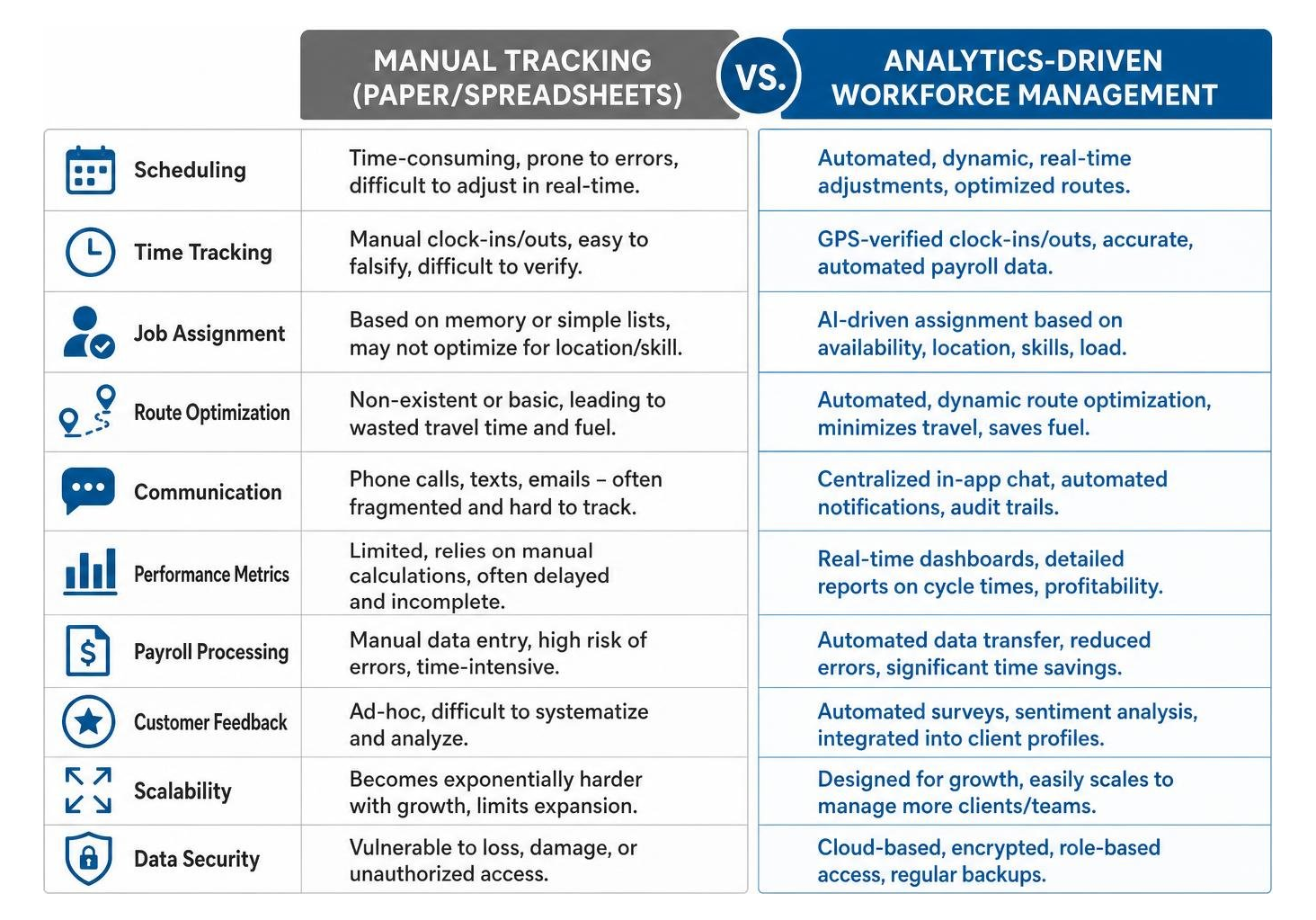
Frequently Asked Questions About Operational Data Systems
As cleaning businesses increasingly adopt sophisticated operational data systems, common questions arise regarding their practical implementation and impact. We’ve compiled answers to some of the most frequently asked questions to help you navigate this transition and maximize the benefits of your investment.
How does advanced reporting directly increase service revenue?
Advanced reporting within cleaning service software directly contributes to increased revenue through several key mechanisms. Firstly, by providing clear insights into your pipeline conversion rates, you can identify where potential clients are dropping off in the sales process and refine your outreach or quoting strategies. This allows for more effective capture of new business.
Secondly, detailed reports on upsell rates highlight opportunities to offer additional services to existing clients, maximizing the value of each customer relationship. When you understand which add-ons are most popular or which client segments are receptive to them, you can tailor your offerings more effectively.
Thirdly, automated reminders and efficient scheduling, backed by data, lead to reduced no-shows. Every missed appointment is lost revenue, and by minimizing these, your operational revenue instantly improves. Finally, by analyzing job profitability and market demand data, businesses can engage in intelligent pricing optimization. This ensures that services are priced competitively yet profitably, avoiding undercharging for high-value work or overcharging for standard services. The ability to see which services are most profitable and adjust pricing accordingly is a direct pathway to revenue growth.
What are the primary data points needed to optimize service routes?
Optimizing service routes is a complex task that relies on several critical data points to achieve maximum efficiency and cost savings. The primary data points include:
- Job Duration: Accurate estimates of how long each cleaning job will take are fundamental. This data often comes from historical job records within the software, allowing for realistic scheduling.
- Traffic Patterns: Real-time and historical traffic data are essential to account for congestion, rush hours, and road closures. Integrating with mapping services that provide this information ensures routes are optimized for actual travel conditions, not just shortest distance.
- Technician Skillsets: For specialized cleaning tasks, knowing which technicians possess the necessary skills ensures that the right person is dispatched to the right job. This prevents delays and ensures quality service.
- Location Density: Understanding the geographical clustering of jobs allows the software to group appointments efficiently, minimizing travel distance between clients. This is crucial for creating logical and fuel-efficient routes.
By combining these data points, cleaning service software can dynamically create routes that not only get crews to their destinations efficiently but also ensure they arrive prepared and on time, enhancing customer satisfaction and operational throughput.
How should service companies manage data migration from manual spreadsheets?
Migrating from manual spreadsheets to a comprehensive cleaning service software can seem daunting, but with a structured approach, it can be a smooth transition. Here’s how we recommend managing it:
- Data Cleansing: Before importing any data, thoroughly clean your existing spreadsheets. Remove duplicate entries, correct inconsistencies, and ensure all information is up-to-date. Inaccurate data going in will result in inaccurate data coming out.
- CSV Import: Most modern cleaning service software offers robust CSV import functionalities. Organize your cleaned data into CSV files, mapping your existing columns to the corresponding fields in the new software. Many providers offer templates or guidance for this process.
- Phased Rollouts: Instead of a “big bang” approach, consider a phased rollout. Start by migrating essential data like client contacts and basic service lists. Then, gradually introduce scheduling and other features. You might even test the new system with a small team or a specific service type first.
- Staff Training: Comprehensive staff training is crucial. Provide clear, hands-on training sessions for all employees who will be using the new system. Highlight how the software will simplify their tasks and improve their daily workflow. Offer ongoing support and create a feedback loop to address any challenges during the transition.
By following these steps, cleaning businesses can ensure a successful data migration, minimizing disruption to daily operations and quickly realizing the benefits of their new software system.
Conclusion
The cleaning service industry, like many others, is undergoing a profound transformation driven by technology. As we’ve explored, cleaning service scheduling software is no longer just a tool for booking appointments; it’s an indispensable platform for driving growth, enhancing efficiency, and securing a competitive edge. By embracing these advanced systems, businesses can make more informed strategic decisions, moving away from reactive management to proactive planning.
The ability to achieve scalable growth is significantly boosted, as these platforms automate administrative burdens, allowing businesses to expand their client base and service offerings without a proportional increase in overhead. Through automated workflows for scheduling, dispatch, invoicing, and communication, countless hours are saved each week, freeing up valuable time for business development and customer engagement. This leads directly to operational excellence, characterized by seamless processes, reduced errors, and consistent service delivery.
The power of these systems lies in their capacity for continuous optimization. The rich data they collect, from job cycle times to customer satisfaction scores, provides the intelligence needed to perpetually refine every aspect of the business. In September 2026, the cleaning businesses that thrive will be those that not only adopt this technology but also leverage its inherent data analytics capabilities to understand, predict, and innovate. Investing in the right cleaning service scheduling software is not just an expense; it’s a strategic investment in the future success and profitability of your business.