






























What Is a Sales Process?
A sales process is a repeatable sequence of steps organized into a systematic process that takes a sales representative through identifying initial prospects down to closing a deal. It is systematic in nature, which changes hit-and-miss selling habits into anticipated revenue inflows.
Sales practices are currently more buyer-oriented as opposed to selling the goods as though they are the answer to every problem. 59% of business buyers are not pleased with what sales reps do on the way to determine their objectives. This fact underscores the reason why formal procedures with emphasis on the customer requirements yield better outcomes.
For sales professionals looking to enhance their lead quality and conversion rates, tools like Snovio’s Email Verifier can help validate prospects before investing valuable time in outreach efforts.
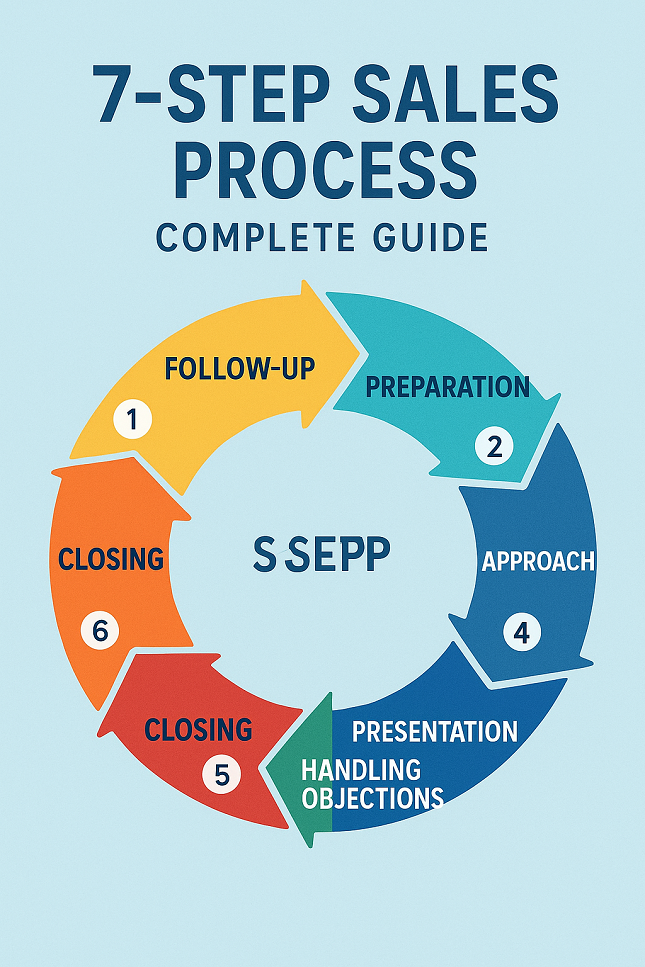
The 7-Step Sales Process
1) Prospecting
Prospecting is the activity of identifying customers who are a good match with your ideal customer profile. This will be your most important first step that determines the quality of your entire pipeline in sales.
Effective prospecting means focusing on research-based methodology as opposed to spray-and-pray methodology. A mere 39% of companies standardize the lead qualification criteria, which means that approximately 55% of the leads might be left unattended. This is a waste of resources and a reason why strategic prospecting is so important.
Some of the prospecting activities are:
- Defining what ideal customer profiles are—the ideal customer profile is a set of specific requirements that a customer will be satisfied with. It describes what characteristics a customer would want a product or service to have.
- Target market research
- Creation of prospect lists
- Identifying decision-makers
- Producing customized outreach plans
2) Qualifying
Lead qualification differentiates the real prospects and the tire-kickers. The elimination of time spent on disqualified leads and the focus on the opportunities with a high potential will occur during this step.
Only 44% of the companies employ a system of lead scoring to determine the quality of the lead. Companies, which establish more methodical approaches to qualification, experience a higher conversion rate and better resource assignment.
Worthwhile qualification frameworks such as BANT (Budget, Authority, Need, Timeline) or MEDDIC provide a way to evaluate viability of prospects. Financial capacity, decision-making capability, the true need, and the future purchase schedule should be considered by the sales representatives.
Questions to pose in the qualification:
- How much money is being spent on this solution?
- Who will make the final buying decision?
- What problems exactly do you want to address?
- What time do you require this to be implemented?
- What will happen in case you make no effort in resolving this question?
3) Research
The detailed prospect research will make possible tailored tactics that appeal to respective buyer requirements. This tactic can make generic pitches into interesting, pertinent discussions.
Studies are expected to reveal organizational history, sector issues, competitive environment, and stakeholder preoccupations. The insight can be gained through LinkedIn, websites of companies, publications in the industry, and news sources.
The aim of good research is to determine:
- Pain points and goals of the company
- New business trends
- Competitive pressures
- Backgrounds of key stakeholders
- History of association with the vendors
4) Pitching
The pitch consists of the value proposition of your solution to the prospective needs. The contemporary pitches are problem-oriented rather than product-oriented.
This can be done using relevant resources through which 95% of customers end up making a purchase with a business that offers them relevant resources to offer assistance at every purchase cycle. This figure shows the significance of buyer-focused presentations.
Effective pitches are made following a sequential story: definition of the problem, introduction of the solution, explanation of benefits, and demonstration of the concept. Effective visual aids, case studies, and demonstrations increase the effectiveness of the message.
Essential pitch elements:
- Proper definition of the problem
- Customized solution summary
- Quantified benefits
- Social proof and testimonials
- Implementation timeline
- Investment requirements
5) Approach
The strategy dictates the manner through which you start and build relationships with prospects. This includes communication channels, the tone of messages, and the frequency of messaging.
A quarter of sales professionals remark that the sales process is too long, and it is likely to be the greatest cause of the prospects withdrawing. The discovery forces the focus on effective, respectful approach strategies.
The newer methods place more emphasis on delivery of value as opposed to intense sales. Every communication must include information, learning, or even a solution which will enhance the decision-making process of the buyer.
Appropriate approach strategies to be employed should be:
- Multi-channel communication strategies
- Content sharing of value addition—in operating business, value creation is only feasible when sharing is done on a value-added basis.
- Frequent meetings and revising
- Duty customer service
- Consultation-based interactions
6) Preparation
Preparation means such steps as collection of requirements, documentation, aligning of stakeholders, and then pursuing opportunities. This will help to avoid delays and comes out as being professional.
Engaging in all aspects of preparation involves development of proposals, legal consideration, implementation strategy, as well as internal team organization. The sales representatives are to expect objections and come up with answers.
Preparation checklist:
- Proposal and contract writing
- Technical conditions, demands, and requirements
- Implementation period and funding—the scope and scope of the implementation
- Prices and terms of payments
- Means of controlling risk
- Teams briefing in-house
7) Close the Sale
The process of closing turns hot prospects into paying clients. This is an act that needs confidence, persistence, and right timing.
The overall industry average sales conversion rates are 2.46-3.26%. Application of the benchmarks aids in creating realistic expectations and leaving outlets of improvement.
Efficient closing methods to use are the assumptive closes, the alternative choice close, and the urgency close. But the best closes are natural, and they follow the decision-making process of the buyer.
Ideal closing practice:
- Jot down or make lists of the agreed benefits
- Address objections too obvious to need citing
- Present concrete next steps
- Make it urgent when necessary
- Signed and secure assurances
- Smooth hand-off to delivery teams
How to Improve Your Sales Process
Optimization of the sales process necessitates regular analysis and constant modification. 83% of the respondents have applied at least one new method or technology to its sales process within the past few years.
One could begin by mapping out the current process and pinpointing the bottlenecks. Measure conversion rates within each step and also get feedback from the sales representatives as well as the customers. Make modest advances in light of this.
Reviewing the processes on a regular basis makes the company adapt to changes in the market and evolutions in the behavior of buyers. Best practices seize success on the part of sellers in your team.
To improve, the following strategies will be used:
- The performance indicators are measured
- The integration of customer feedback
- Competitive benchmarking
- Technology adoption
- Constant training
Best Practices for a Profitable Sales Process
Automate Your Sales
Sales automation will remove the repetition and guarantee consistent engagement with prospects. 61% of high-performers in sales have a CRM to automate their sales processes.
The automation tools can manage lead scoring, email sequences, appointment setting, and reminders. The technology enables sales representatives to pay attention to their more valuable activities such as relationship building and deal development.
The key areas of automation:
- Lead scoring
- Lead nurturing campaigns
- Appointment scheduling
- Proposal generation
- Performance reporting
Establish a Sales Script
Sales scripts bring uniformity to them but make them personable. Such frameworks make sure that they cover important points but not in a mechanical and artificial way.
Quality scripts must have conversation openers, qualifying questions, complaint answers, and closing. They should be a versatile solution to the various personalities of buyers and situations.
Script development takes place in:
- Identifying the characteristic situations
- Design of message structures
- Insert customization details
- Train the real potentials
- Performance optimization
Refine and Optimize Your Sales Process
The constant process of optimization also keeps you on top of your sales process as the environment in the market changes. Periodic review establishes the point of improvement and expunges areas of inefficiencies.
Track such critical performance measures as conversion performance, cycle times, and revenue per possibilities. Examine the performance within the group members with the knowledge of what is the most effective and training needs.
Optimization activities:
- A/B experiments
- Market trend evaluation
- Market trend analysis
- Competitor analysis
- Forecast market trend
Recognize Bottlenecks and Resolve Them
Sales bottlenecks lower efficiency and affect their revenue generation capabilities. 65% of sales leaders also find it hard to adjust strategic plans because of unresolved process restrictions.
The likely bottlenecks are long-time approval processes, poor quality of leads, lack of product knowledge, and cross-departmental coordination. These problems can only be solved using systematic methods of problem-solving.
There are methods of identifying bottlenecks:
- Pipeline selling analysis
- Time-to-close tracking
- Group review sessions
- Customer satisfaction surveys
- Win/loss analysis
Sales Enablement
Sales enablement is a solution to make sales representatives successful and provide tools, content, and training. Companies that have a sales enablement strategy have a 49% higher win rate on the deals that they forecast.
The product training, competitive intelligence, sales tools, content libraries, and coaching material will be enabling. Such programs must be consistent with the stages of your sales process and buyer journey needs.
Enablement components:
- Training and development programs
- Sales content library
- Competitive intelligence
- Hints and information technology
- Performance coaching
Sales Process – Common Mistakes
Most companies commit severe mistakes that will hurt the effectiveness of sales processes. Recognizing these pitfalls prevents pitfalls of the same kind.
The most frequent errors can be described as follows:
- Focusing on features as compared to benefits
- High-speed accreditation procedures
- Follow-up activities are not done
- Utilizing non-individual as opposed to individual tactics
- The inability to get customer feedback
The other common mistake is the lack of proper adoption of technology. One-third of the sales and marketing experts are using AI on a day-to-day basis, whereas most companies are unwilling to modernize.
Another category of process mistakes is inadequate training and role ambiguity and a lack of measuring performance. The issues result in poor performance and loss of revenues.
Prevention strategies:
- Ordinary training programs
- Proper recording of the procedures
- Performance monitoring systems
- Customer feedback integration
- Technology investment
Wrap Up
An effective 7-step sales process converts hit-or-miss selling behavior to revenue efforts. There are skills, tools, and strategies that are required in each stage from prospect process to closing.
Improvement, technology usage, and customer-driven strategies are the keys to success. Organizations with aligned sales and marketing are 36% more likely to retain customers and 38% more likely to win their deals, which justifies the worth of process-oriented methods.
Organizations implementing structured sales processes experience better conversion rates, reduced sales cycles, and greater customer satisfaction. The current benefits have direct effects on the bottom-line performance and competitive standing.