



























Resignation is rarely a sudden decision. It is the endpoint of a process that began months earlier, when a specific set of conditions started to erode the employee’s sense that staying was the right choice. Research on voluntary attrition consistently identifies the same preconditions: the employee stopped seeing a clear path forward, their manager became less available, their contribution felt invisible to the organization, and the daily friction of their working environment quietly accumulated into a weight they eventually decided not to carry anymore. By the time the resignation letter arrives, the organization has already lost the employee in every meaningful sense. The question most organizations ask too late is what could have been done differently. The answer is almost always infrastructural rather than managerial. The conditions that precede resignation are not created by bad managers. They are created by organizations that never built the environment where those conditions could be prevented at scale. That environment is built on project management tools that make growth, visibility, connection, and contribution structural features of the daily working experience rather than outcomes that depend on individual manager effort.
Clarity about where the career goes next with Lark OKR
The most common precursor to a resignation decision is a period of sustained uncertainty about whether the current role is still the right one. This uncertainty is not usually about compensation or workload. It is about direction: the employee cannot see how their current work is building toward anything beyond the immediate task, and the organization has not given them a structural way to answer that question for themselves. The manager who might have provided that clarity is stretched across too many direct reports to have the conversation at the frequency the employee needs it.
Lark OKR gives employees a permanent, self-serve view of how their individual work connects to the team’s objectives and the company’s strategic direction. Every team member can set their own key results that link directly to their department’s goals, creating a visible thread between what they do every day and what the organization is working toward. Regular check-in cycles within the OKR framework prompt structured conversations about progress and development on a predictable schedule, so the career direction conversation happens as a built-in feature of the goal cycle rather than only when a manager finds the time to initiate it. Employees who can see their own trajectory stay because staying makes sense, not because they have not yet found somewhere else to go.
A manager who is present even when they are not available with Lark Messenger
One of the earliest signs that an employee is disengaging is a gradual reduction in the quality of their communication with their manager. The messages become shorter. The questions stop coming. The enthusiasm that used to show up in chat exchanges flattens into transactional brevity. By the time a manager notices the pattern, it has usually been developing for weeks, and the window for an easy intervention has already narrowed considerably. The challenge for most managers in growing organizations is that they are managing too many people across too many time zones to maintain the communication frequency that early detection requires.
Lark Messenger gives managers the structural tools to maintain consistent, human communication with their teams without requiring every touchpoint to be a real-time conversation. “Scheduled Messages” allow managers to compose regular check-in messages, recognition notes, and encouragement that arrive at the right moment for each team member regardless of schedule differences. “Read/Unread Status” confirms that important communications have landed without requiring a follow-up that can feel intrusive, so the manager maintains awareness of whether the team member is engaged without having to ask explicitly. “Rich Formatting” preserves the warmth and personality of communication that makes a manager’s messages feel like genuine connection rather than operational broadcasts, even when they are sent at scale across a large and distributed team.
Work that is visible and attributed to the right person with Lark Docs
A specific kind of disengagement accumulates when an employee does the substantive work on a project and then watches the recognition for that work accrue to whoever was most visible in the final meeting. The credit problem in organizations is partly a culture problem and partly an infrastructure problem. When there is no permanent record of who contributed what and when, recognition defaults to whoever was in the room, and the team member who was working late to produce the analysis that everyone is now discussing has no objective basis for correcting the attribution.
Lark Docs solves the attribution problem at the infrastructure level. “Version History” records every contribution with the contributor’s name and a timestamp, so the full record of who built what is permanently available and verifiable by anyone with access to the document. “@mention” ensures that when a team member completes an action that was assigned to them within a document, the resolution is visible to all other contributors rather than only to the person who left the original comment. Over time, the document record becomes a portfolio of contribution that both the team member and their manager can reference in development conversations, creating an objective basis for recognition that does not depend on who happened to be most vocal in the meeting where the work was presented.
Operational clarity that prevents the groundhog day feeling with Lark Base
A specific form of disengagement that rarely gets named is the feeling of operational futility: the sense that the work done this week is essentially the same as the work done last week and the week before, without any visible accumulation or progress. This feeling is particularly common in operations, customer success, and support roles where the nature of the work is repetitive by design but the organizational picture often fails to show how that repetitive work is contributing to something larger. The employee who cannot see the progress they are making across a meaningful time horizon eventually stops feeling that the effort is worth sustaining.
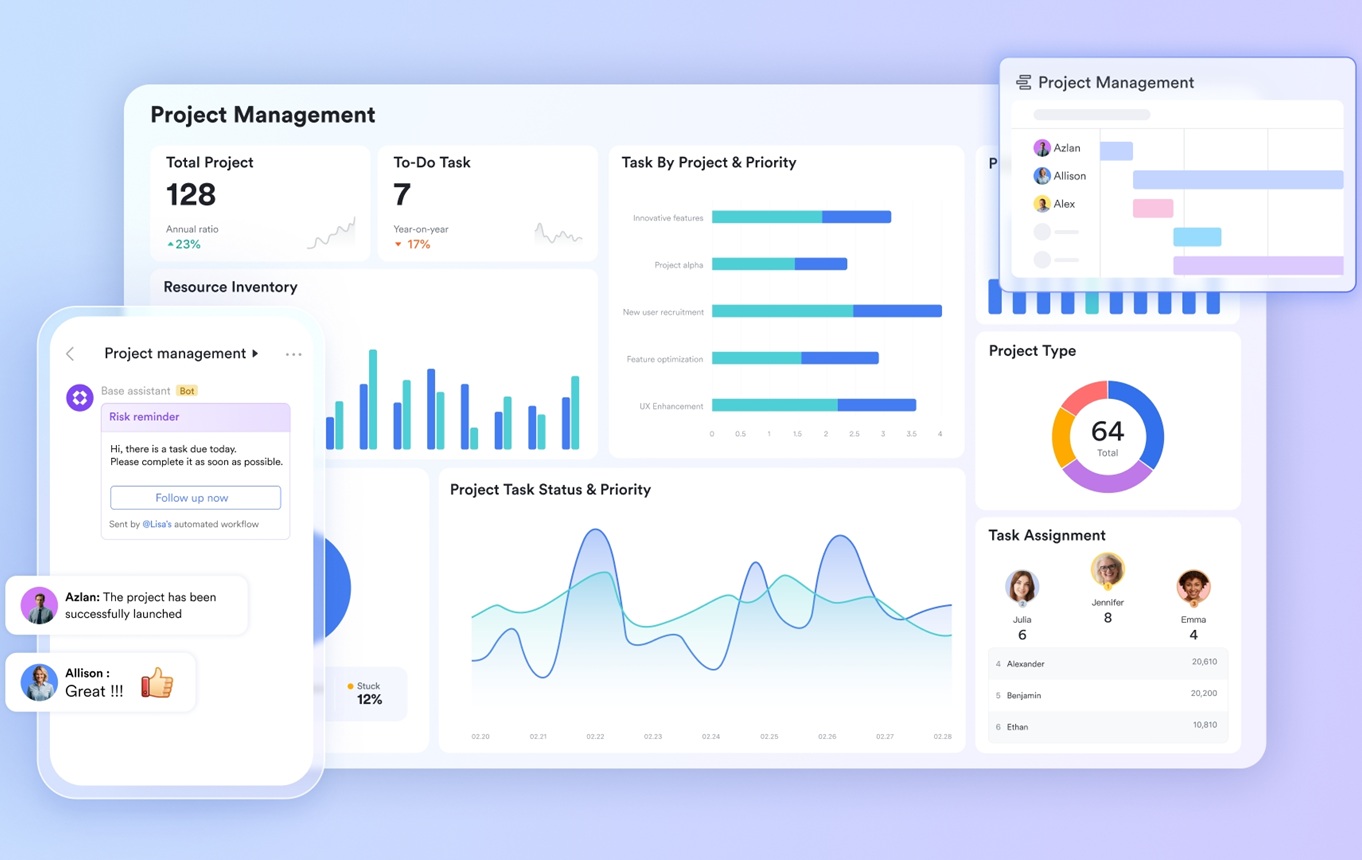
Lark Base gives team members a live, personal view of their own operational output over time. Personal task views allow each team member to filter the shared database to show their own completed work, their current priorities, and their upcoming deadlines in a format that makes the accumulation of their contribution visible rather than invisible. Shared dashboards can be configured to show team-level progress metrics alongside individual contribution, so the team member who spent the week processing requests can see exactly how their work contributed to the team’s overall throughput rather than feeling that each week disappears without a trace.
A schedule that respects working capacity with Lark Calendar
Overload is one of the most reliable predictors of resignation in high-performing employees because high performers are disproportionately likely to be added to every new initiative, asked to cover every gap, and invited to every meeting that touches their area of expertise. Their calendar fills in ways that their peers’ calendars do not, and because their output remains high for longer than average, the overload is rarely flagged until the employee flags it themselves in a resignation conversation. By that point, the organization has already benefited from months of unsustainable output at the employee’s personal cost.
Lark Calendar gives high-performing employees the tools to make their capacity visible without requiring a confrontational conversation about workload. “Calendar Subscription” allows teams to see shared focus-time blocks and protected working periods, so the default assumption that a high performer is always available for an additional meeting is replaced by visible evidence of their existing commitments. “Schedule in Chat” makes scheduling transparent by showing all participants’ availability simultaneously, so the person who is most in demand is not consistently the one whose preferences are overridden when a meeting time is selected because their calendar was checked last. “Meeting Groups” ensure that meetings are prepared in advance rather than consuming additional time through in-meeting catch-up, so the high performer who does attend a meeting gets the full value of that time rather than spending it on context they should have received beforehand.
Bonus: What the data consistently shows before a resignation
Exit interviews are a useful but imperfect instrument because they ask departing employees to articulate reasons for a decision that was made through a gradual emotional process rather than a conscious analytical one. The more reliable signal comes from behavioral data gathered before the resignation: the reduction in message frequency, the decline in discretionary contribution, the increase in time between task initiation and completion, and the gradual withdrawal from optional team activities.
Most organizations have neither the infrastructure to detect these signals nor the tools to address them when detected. Platforms like Lattice and Culture Amp offer engagement measurement. Tools like Slack and Zoom facilitate communication. Microsoft Teams and Notion provide collaboration surfaces. But none of these is connected well enough to generate the unified behavioral picture that would allow a manager or an HR team to notice that a specific employee has been quietly disengaging for six weeks. Looking at Google Workspace pricing as a base alongside these specialist engagement tools reveals a system designed to measure the problem rather than prevent it. Lark creates the conditions where the problem is less likely to develop in the first place.
Conclusion
The best people do not leave because better offers always exist. They leave because the conditions that make staying compelling stopped being present in their daily working experience. A connected set of productivity tools that makes career direction visible, manager presence consistent, individual contribution attributed, operational progress tangible, and scheduling capacity respected creates those conditions structurally rather than leaving them to the discretion and bandwidth of individual managers who are already stretched.