


























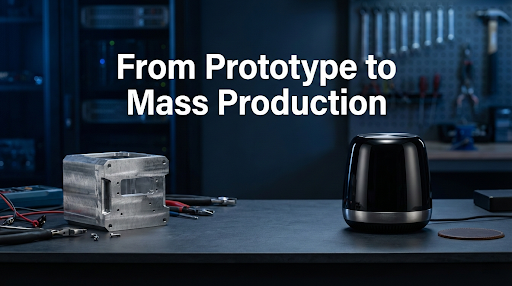
Hardware development is a notoriously unforgiving landscape. For ambitious founders, the journey from a brilliant concept or a perfectly functioning lab prototype to a market-ready, commercially viable product is fraught with hidden challenges. Industry insiders commonly refer to this perilous 18-to-24-month transition period as the “Valley of Death.”
Sobering statistics reveal that up to 90% of hardware startups fail to make it across this chasm. These failures are rarely due to a flawed core idea; rather, they stem from a systemic underestimation of the manufacturing process. Founders often underestimate development timelines by a factor of two to four, and the complexity of manufacturing by as much as ten.
To survive this brutal transition, innovation alone is not enough. Hardware companies need a battle-tested hardware manufacturing roadmap that aligns design intent with factory-floor realities. This guide explores the critical stages of that journey, providing actionable insights on how to successfully navigate the leap from prototype to production without draining your capital.
1) DFM & Prototyping: Laying a Scalable Foundation
In the earliest stages of hardware development, founders frequently ask how to manufacture a prototype product that looks and feels like the final vision. However, the more pressing question should be: how do we design a prototype that can eventually be manufactured at scale?
This is where Design for Manufacturing (DFM) becomes the most critical tool in a startup’s arsenal. A 3D-printed prototype might function beautifully in the lab, but if its geometry features uneven wall thicknesses, impossible undercuts, or zero draft angles, it will fail in a high-volume injection molding press.
Engaging a specialized manufacturing partner early is the ultimate risk mitigation strategy. Companies like HordRT excel by bringing their engineering teams into the product lifecycle at the prototype stage to provide comprehensive, upfront DFM feedback. By identifying and resolving manufacturing bottlenecks before any steel is cut, HordRT helps startups save thousands of dollars in expensive re-tooling and prevents weeks of delayed launch timelines.
2) Validation (EVT/DVT): Bridging Theory and Reality
Once the initial prototype is refined, the product must undergo brutal, real-world testing through Engineering Validation Testing (EVT) and Design Validation Testing (DVT). At this stage, your product cannot just look the part; it must perform under physical stress, thermal constraints, and daily wear-and-tear exactly as the final mass-produced unit would.
Simple additive manufacturing is no longer sufficient for these rigorous test loops. Startups must utilize production-grade materials to validate functionality, durability, and tight assembly tolerances. Utilizing Rapid CNC Machining and Rapid Tooling allows engineering teams to produce batches of tens to hundreds of functional units. HordRT’s rapid turnaround in this phase empowers engineers to iterate quickly, physically test their designs under real stress, and secure necessary regulatory certifications (such as CE, FCC, or UL) with absolute confidence.
3) Bridge Production: Scaling Smartly
The transition from validating a few dozen units to fulfilling a sudden surge of thousands of pre-orders is where cash flow is most vulnerable. Committing tens of thousands of dollars to high-capacity, multi-cavity steel molds (Hard Tooling) before the market has fully validated the product is a massive financial gamble. If the design requires a post-launch tweak, that expensive mold could become a total write-off.
Bridge Production is the strategic middle ground. It allows startups to scale output seamlessly without absorbing the crippling upfront costs of mass-production tooling. HordRT serves as a vital growth catalyst here by utilizing its Master Unit Die (MUD) shared mold system. Because HordRT owns the standard mold base, clients only pay for the custom cavities and cores. This unique approach slashes tooling costs by 30% to 50% and reduces lead times to a mere 7 to 14 days. Combined with a strict “No Minimum Order Quantity” (No MOQ) policy, HordRT enables startups to run low-risk, small-batch market tests.
4) Full-Scale Launch: Transitioning to Mass Production
Once the product achieves strong product-market fit and the order volume justifies the investment, the focus of manufacturing shifts toward Production Validation Testing (PVT) and full-scale mass production. At this magnitude, unit economics rule everything. The operational goals pivot to maximizing Yield, improving Overall Equipment Effectiveness (OEE), and driving the piece-part cost down to its absolute minimum.
Scaling to this level requires incredibly stable, high-efficiency molds designed to run flawlessly for years. HordRT proves its value not just as a rapid prototyping shop, but as a full-cycle manufacturing powerhouse. By engineering and building SPI Class 101 and 102 hardened steel molds—guaranteed for over 1,000,000 shots—HordRT ensures that the manufacturing process is highly consistent, delivering the exact same quality on the millionth part as it did on the first.
Conclusion
Transitioning a physical product from a nascent idea to a global launch is one of the most complex endeavors in business. The “Valley of Death” is littered with great ideas that simply couldn’t scale. However, by strictly adhering to a disciplined validation roadmap and utilizing smart capital-preservation strategies like bridge tooling, hardware startups can drastically reduce their exposure to risk.
The ultimate key to surviving and thriving is choosing a manufacturing partner that does more than just machine parts to a drawing. You need a strategic collaborator. From providing the critical DFM feedback on your very first prototype, to executing low-risk bridge production, right through to managing your high-volume, million-part global launch, a full-stack partner like HordRT provides the expertise and infrastructure hardware startups need to conquer the market.