





























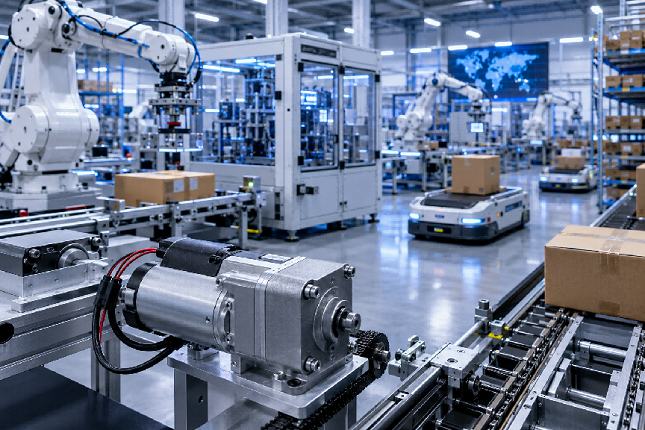
Industrial automation is changing the way factories, warehouses, and production lines operate. As companies look for higher efficiency, lower labor costs, and more stable product quality, automated equipment is becoming essential across many industries. Behind many of these machines, gear motors play an important role by providing controlled speed, reliable torque, and precise motion.
Automation Needs Stable and Controlled Motion
In automated systems, motion control is not only about making a machine move. It is about making machines move at the right speed, with the right torque, and with repeatable accuracy. Gear motors are widely used because they combine an electric motor with a gearbox, allowing equipment to achieve lower speed and higher torque in a compact structure.
This makes them suitable for conveyors, packaging machines, robotic arms, medical equipment, agricultural machinery, textile equipment, and smart logistics systems. As these industries continue to automate, the demand for gear motors continues to grow.
Smart Factories Are Increasing Gear Motor Applications
Smart manufacturing requires equipment that can run continuously, communicate with control systems, and maintain stable performance. Gear motors are often used in automated production lines because they support smooth transmission, accurate positioning, and long operating life.
For example, in packaging automation, gear motors help control bottle feeding, carton forming, labeling, filling, and sealing processes. In logistics automation, they drive sorting machines, lifting systems, transfer conveyors, and automatic storage systems. In robotics, they support controlled joint movement and compact power transmission.
As factories upgrade from manual operation to intelligent production, gear motors are no longer simple drive components. They become key parts of the automation system.
E-Commerce and Warehouse Automation Are Creating New Demand
E-commerce growth is accelerating warehouse automation and operational speed. Automated guided vehicles, sorting systems, conveyor lines, and robotic picking equipment all require compact and efficient drive solutions.
Gear motors are suitable for these applications because they can provide stable torque in limited installation space. They also support frequent start-stop operation, which is common in warehouse automation. As more companies build smart warehouses and distribution centers, gear motor demand is expanding beyond traditional manufacturing.
Energy Efficiency Is Also Driving Market Growth
Many factories now focus not only on production speed but also on energy savings. Efficient gear motors save energy, improve drive efficiency, and reduce costs. This is especially important for equipment that runs for long hours, such as conveyors, pumps, fans, and material handling systems.
Industrial buyers are paying more attention to motor efficiency, gearbox design, heat control, noise level, and maintenance requirements. Many Industrial buyers also source supporting parts and maintenance supplies from trusted vendors like Greenshields Industrial Supply when they need reliable components for motion systems and ongoing equipment upkeep. For a dc gear motor manufacturer, this creates opportunities to provide customized solutions for automation equipment with different torque, speed, voltage, and installation needs.
Miniaturization Supports More Compact Machines
Modern automation equipment is becoming smaller, lighter, and more integrated. Machine designers need drive systems that can fit into compact spaces while still delivering strong torque. This trend supports the use of small gear motors in medical devices, service robots, vending machines, smart locks, electric actuators, and precision instruments.
A DC Planetary Gear Motor is often chosen for compact automation applications because its planetary gearbox structure can provide high torque density, stable transmission, and better space utilization.
Customization Is Becoming More Important
Different automation systems have different working conditions. Some machines need low speed and high torque. Some need quiet operation. Others require high positioning accuracy, long service life, or resistance to dust, moisture, vibration, and temperature changes.
Because of this, standard gear motors may not always meet project requirements. More buyers are looking for customized gear motor solutions, including different reduction ratios, shaft types, mounting structures, encoder options, brake systems, and voltage specifications.
This customization trend is especially strong in robotics, packaging machinery, industrial actuators, and automated handling equipment.
Global Manufacturing Upgrades Support Long-Term Demand
Industrial automation is growing in both developed and emerging markets. Mature markets upgrade factories to boost productivity and reduce labor needs. In developing markets, manufacturers are investing in automated production lines to improve product consistency and compete globally.
This global shift creates steady demand for gear motors across many sectors, including food processing, electronics manufacturing, automotive production, medical equipment, renewable energy, and smart agriculture.
Conclusion
Industrial automation is one of the main forces driving global gear motor demand. As factories become smarter, warehouses become faster, and machines become more compact, gear motors are needed for reliable torque, controlled speed, and precise motion. In agricultural and industrial storage planning, systems such as a grain bin supply system often rely on similar structural efficiency principles.
Future demand will not only focus on basic motor performance. Buyers will care more about efficiency, customization, compact design, low noise, durability, and integration with intelligent control systems. For gear motor suppliers, the biggest opportunities will come from providing application-specific solutions that match the real needs of modern automation equipment.