


























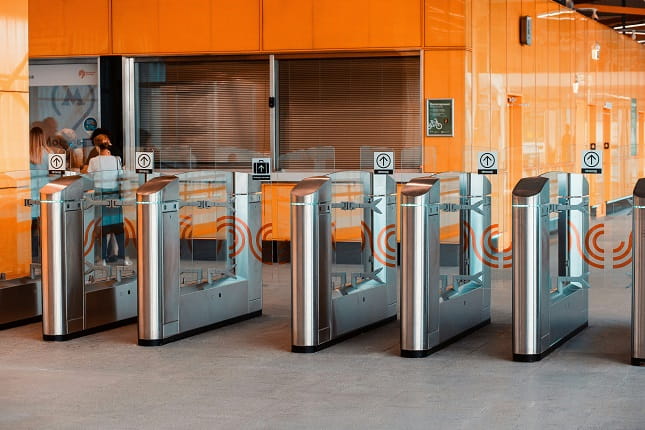
Installing a turnstile in a New York office building, construction site, residential property or commercial facility can look like a relatively straightforward purchasing decision.
Choose the right model, connect it to an access control system and install it at the entrance.
In reality, the hardware itself is only one part of the equation.
For businesses and property managers, the bigger question is often who is standing behind that hardware once it has been installed.
This becomes particularly important in New York, where access systems can be used by hundreds or even thousands of people every day. If a turnstile stops functioning, waiting days for a replacement component or an outside technician can quickly become an operational problem.
Manufacturer, Distributor or Installer?
Not every company selling turnstiles operates in the same way.
Some businesses primarily act as distributors. They purchase equipment from manufacturers and then sell or install it for the customer.
Others operate more like full-service turnstile companies, controlling several parts of the process themselves, including product engineering, manufacturing or assembly, inventory, installation, replacement parts and ongoing technical support.
Neither model is automatically wrong.
However, buyers should understand which type of company they are dealing with before signing a contract.
A distributor may offer an excellent product, but when something goes wrong it may need to contact the manufacturer before a replacement component can be sourced.
When the supplier controls more of the process directly, there can be fewer companies standing between the customer and the solution.
Why Local Inventory Matters
One of the easiest questions to overlook when purchasing access-control equipment is:
Where are the replacement parts?
A turnstile can remain in operation for years, which means its maintenance requirements matter considerably more than they might for a simple one-time purchase.
Motors, control boards, sensors, locking mechanisms and other components can eventually require servicing or replacement.
If those components have to be ordered internationally, a relatively minor technical problem can turn into a much longer interruption.
This is why New York businesses should ask potential suppliers whether they maintain local or readily available inventories of both complete systems and commonly required replacement parts.
The issue becomes particularly important for properties where the turnstile is integrated with employee access, visitor management or building security.
The 24–48 Hour Question
Another useful test is to ask a supplier what happens at 9 a.m. on Monday morning if a turnstile unexpectedly stops working.
Who answers the call?
Does the company have its own technicians?
Are those technicians located in the New York area?
Can someone realistically reach the property within 24 to 48 hours?
And perhaps most importantly: will that technician actually have access to the parts required to repair the system?
New York has companies operating across very different parts of this spectrum.
Some specialize mainly in sales or installation, while others combine equipment supply with technical and after-sales support.
ROM Technologies, for example, supplies commercial turnstile systems and related entrance-control equipment. Businesses comparing locally supported solutions can review its product range directly at https://romtech-usa.com/.
The important point isn’t simply which company a business chooses. It is understanding exactly what capabilities exist behind the supplier.
Ask Who Actually Makes the Equipment
The same principle applies to manufacturing.
A company advertising a turnstile under its own name does not necessarily manufacture the underlying system.
Before purchasing, commercial buyers should ask several straightforward questions:
- Who manufactures the actual turnstile?
- Where is it manufactured or assembled?
- Who stocks replacement components?
- Who performs warranty repairs?
- Who handles the electronics and access-control integration?
- Are service technicians employees, dedicated partners or unrelated subcontractors?
- How quickly can technical support reach a New York property?
These questions can reveal considerably more about a supplier than the product brochure alone.
Consider the Entire Life of the System
Businesses frequently compare security equipment based primarily on the initial quote.
That can be misleading.
A cheaper installation can become considerably more expensive if replacement components are difficult to obtain or every service call requires coordinating several different vendors.
Instead, businesses should consider what could be called the lifecycle cost of the entrance system.
That includes the original equipment and installation but also maintenance, replacement parts, technical support, downtime and eventually upgrades or integrations with newer access-control systems.
For a turnstile expected to operate for many years, those factors can matter more than a small difference in the initial purchase price.
Integration Is Just as Important as Hardware
Modern turnstiles are also increasingly connected to wider building systems.
Depending on the property, a turnstile might interact with employee credentials, card readers, visitor systems, biometric readers, security software or other access-control infrastructure.
This means businesses are rarely purchasing an isolated piece of stainless steel.
They are purchasing one component of a larger security system.
A supplier therefore needs to understand not just mechanical installation but how the turnstile communicates with the systems surrounding it.
That is another reason businesses should evaluate the technical capabilities of the company behind the equipment rather than comparing products solely by appearance or price.
Buy the Support Network, Not Just the Hardware
Turnstiles can look surprisingly similar when viewed in a catalogue.
The difference becomes much clearer several years later when a component fails, a building changes its access-control platform or a facility needs an urgent repair.
For New York businesses, the smartest procurement process therefore goes beyond asking, “How much does this turnstile cost?”
It should also ask:
Who made it, who has the parts and who is going to show up when we need help?
Those answers may ultimately be far more valuable than the equipment itself.