
























Banner blindness isn’t new. Researchers first documented the phenomenon in 1998 — the same year Google was founded. Users, they found, had already learned to visually filter out anything that looked like an ad on a webpage.
That was 27 years ago. Since then, the average person has been exposed to somewhere between 4,000 and 10,000 ad impressions per day. The filtering reflex hasn’t weakened. It’s gotten faster, more automatic, and more sophisticated.
In 2025, banner blindness isn’t just a display advertising problem. It’s a full-spectrum attention problem — and understanding it is the first step to building campaigns that actually get seen.
What Banner Blindness Actually Is (And Isn’t)
Banner blindness is the tendency for users to ignore page elements that look like advertisements, regardless of whether they’re consciously trying to. It’s not skepticism or ad avoidance — it’s a pre-conscious perceptual filter. The eye literally routes around ad-shaped objects before the brain has a chance to evaluate them.
Eye-tracking studies consistently show the same pattern: users read content in an F-shaped or Z-shaped scan path, and their gaze avoids the top banner zone, the right sidebar, and any element with a rectangular border, bright contrasting colors, or stock-photo imagery. These visual cues have become so reliably associated with ads that the brain treats them as noise.
What makes this particularly challenging in 2025 is that users are now applying the same filter to formats that weren’t originally “ad-shaped.” Sponsored content labels, native recommendation widgets, and even some push notification styles have become familiar enough that users have developed secondary blindness to them too.
The implication is uncomfortable but important: the problem isn’t the channel. It’s predictability.
The Five Patterns That Trigger Banner Blindness
Understanding what users are actually filtering helps you design around it. These are the visual and behavioral patterns that reliably get ignored:
1. Fixed position, fixed size. Leaderboard banners at the top of the page, 300×250 rectangles in the right sidebar — users know exactly where ads go on a standard webpage. Anything in those slots gets skipped reflexively, regardless of creative quality.
2. Stock photography. Images featuring smiling people in office settings, generic product shots on white backgrounds, or any image that looks like it came from a subscription library signal “ad” immediately. The brain pattern-matches and moves on.
3. Contrasting borders and backgrounds. A banner that sits inside a visible rectangular border, or has a dramatically different background color from the surrounding content, announces itself as an external element — and gets treated accordingly.
4. Promotional language in headlines. “Click here,” “Limited time offer,” “Buy now,” “Free trial” — these phrases activate the ad filter before the user reads anything else. They’re not just ineffective; they actively accelerate dismissal.
5. Animation for animation’s sake. Flashing, bouncing, or looping animations that serve no informational purpose were aggressive in 2005 and are instantly dismissed today. They signal low-quality advertising and often trigger active annoyance rather than just passive filtering.
Format Choices That Sidestep the Filter
The most direct response to banner blindness is choosing formats that don’t look like the thing users have learned to ignore.
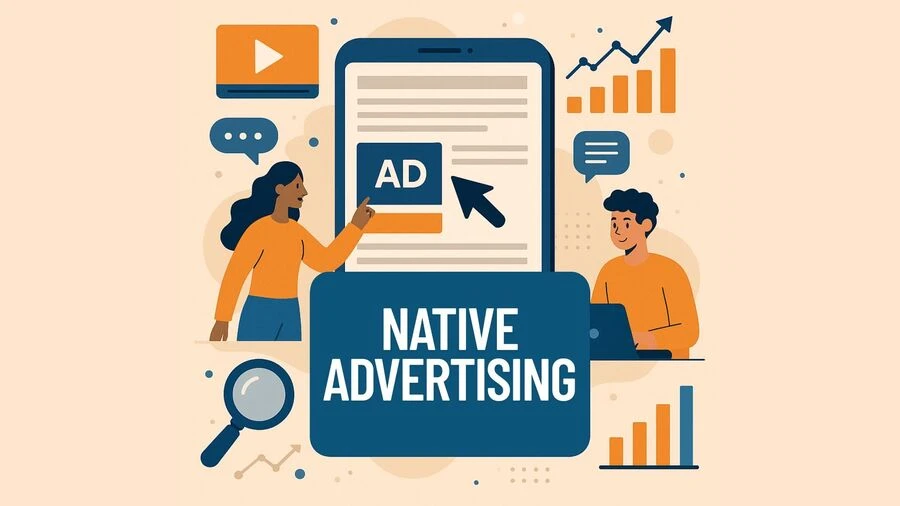
Native advertising is the clearest example. A native unit that matches the font, layout, and content style of the surrounding editorial material isn’t “invisible” — it’s clearly labeled as sponsored — but it doesn’t trigger the reflexive skip because it doesn’t match the visual pattern of a traditional ad. Users read it because it looks like content worth reading.
The key distinction: native advertising earns attention by matching context. It’s not about disguising an ad as editorial — that’s both ineffective and ethically problematic. It’s about presenting information in a format that invites reading rather than rejection.
Push notifications sidestep banner blindness entirely because they don’t live on a webpage at all. They appear in the notification layer of the operating system — a context where users have a different relationship with incoming information. The blindness reflex is trained on webpage layouts; it doesn’t transfer to the notification tray in the same way.
That said, push has developed its own version of the problem. Users who receive too many push notifications from too many sources start ignoring them wholesale — a behavioral blindness rather than a visual one. The antidote is the same: relevance and restraint.
Popunder advertising formats work on a similar logic of context separation. Because the ad surfaces in a separate window rather than within the content layout, it exists outside the zone where banner blindness operates. The user encounters it on their own terms, in a moment of transition, which changes the attentional dynamic entirely.
Creative Strategies That Restore Visibility
Format is half the answer. The other half is what’s inside the ad.
Use real imagery. Photography that shows actual products in real environments, genuine people in authentic situations, or specific visual details that couldn’t come from a stock library bypasses the “generic ad” pattern match. Specificity reads as credibility.
Write headlines that inform, not sell. “The three things holding back your campaign ROI” performs better than “Boost your ROI today.” The first triggers curiosity; the second triggers the promotional language filter. Information-forward copy is the native language of content environments.
Respect whitespace and scale. Ads that don’t feel visually aggressive — that aren’t fighting for attention through size, brightness, or motion — paradoxically get more attention. A calm, well-designed creative in a relevant context outperforms a maximalist one competing with the page.
Match the environment. An ad for a B2B software tool should look different on a tech news site than on a general interest blog. Adapting creative to the visual language of each placement context reduces the “foreign object” signal that triggers filtering.
Test dynamic creative. Static ads that serve the same visual to every user become predictable fast. Dynamic creatives that adjust imagery, headline, or CTA based on the user’s profile or behavior maintain novelty — and novelty is the primary antidote to blindness.
The Measurement Problem
One reason banner blindness is persistently underestimated is that standard metrics don’t capture it well.
Impressions are counted when an ad loads, not when it’s seen. A banner can register as an impression while existing entirely outside the user’s visual field. Click-through rates average around 0.1% for display advertising industry-wide — meaning 999 out of every 1,000 impressions generate no measurable engagement — yet campaigns continue to run because impressions keep accumulating.
The shift to viewability metrics (measuring whether an ad was actually on screen for a minimum duration) helps, but doesn’t fully solve the problem. An ad can be technically viewable and still be visually filtered.
More useful signals: scroll depth correlation (did users scroll past the ad position?), hover data (did any cursor movement happen near the ad?), and post-impression conversion tracking (did users who saw the ad convert later, even without clicking?). These give a more honest picture of whether an ad is generating real attention.
The Strategic Takeaway
Banner blindness in 2025 is not a problem you solve once. It’s an ongoing calibration between format choice, creative quality, placement context, and audience familiarity.
The advertisers who consistently outperform aren’t necessarily spending more — they’re diversifying their format mix, investing in creative that respects the user’s intelligence, and measuring actual attention rather than technical delivery. Networks that support multi-format campaigns with real-time performance data give you the infrastructure to make that calibration continuously rather than guessing from quarterly reports.
The users haven’t stopped paying attention. They’ve just gotten better at deciding what deserves it.