



























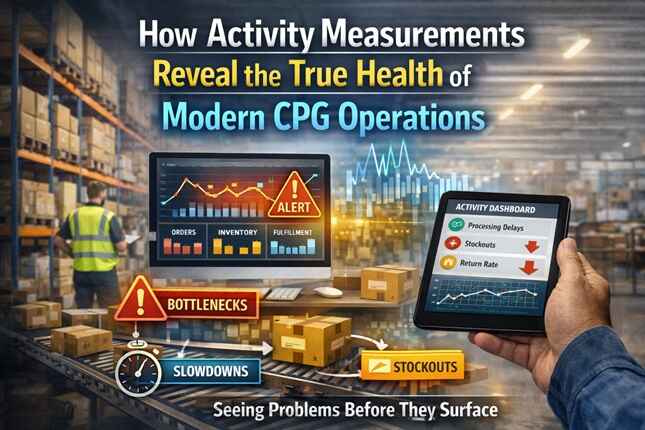
Most consumer packaged goods companies track performance. Revenue, margins, inventory turns, and fulfillment rates all make their way into reports. Yet many teams still feel surprised when problems surface. A product suddenly runs out. Orders back up. Cash flow tightens faster than expected. On paper, everything looked fine.
The disconnect usually comes down to what is being measured and when. Traditional metrics often tell you what already happened. Activity measurements, by contrast, show what is happening right now and where strain is building beneath the surface. When used thoughtfully, they become early indicators of operational health rather than post-mortem explanations. For modern CPG businesses, activity-level visibility is no longer a nice-to-have. It is how leaders spot friction early and keep growth from outpacing operations.
Why Inventory Activity Matters More Than Inventory Totals
Many CPG teams still anchor planning discussions around inventory counts. How much product is on hand. How much is committed. How much is on order. Those numbers matter, but they are static snapshots. What really signals operational health is how inventory is behaving.
Using a robust inventory management software gives teams visibility into inventory movement rather than just inventory volume. When inventory management software tracks how quickly items move through warehouses, how often stock is reallocated between channels, and where bottlenecks form, it starts to tell a deeper story.
Healthy operations show consistent flow. Products arrive, get processed, and ship without excessive delays or manual intervention. When activity data shows frequent overrides, last-minute transfers, or repeated stock adjustments, it is often a sign that planning assumptions are misaligned with reality.
For CPG leaders, paying attention to these activity signals helps prevent bigger issues. Slow-moving stock might indicate demand forecasting problems. Constant expediting could point to supplier reliability issues. Inventory software turns those signals into something teams can actually act on before problems cascade.
E-Commerce Activity Signals That Reveal Operational Strain
As more CPG brands expand direct-to-consumer and marketplace sales, e-commerce activity has become a major driver of operational complexity. Orders arrive around the clock. Customer expectations are immediate. Small inefficiencies compound quickly.
Modern e-commerce stacks generate valuable activity data beyond simple sales numbers. Order processing time, fulfillment accuracy, return frequency, and customer service interactions all offer clues about operational health.
When order volumes rise but fulfillment times stretch, the issue may not be demand. It may be picking processes, warehouse layout, or system integration gaps. When returns spike for specific SKUs, the root cause could be packaging, labeling, or product descriptions rather than the product itself.
Healthy e-commerce operations show predictable rhythms. Orders flow through systems smoothly. Exceptions stand out clearly rather than blending into daily noise. Activity measurements help teams see whether growth is being absorbed efficiently or quietly stressing the system.
Operational Health Lives in the Space Between Departments
One of the most overlooked aspects of activity measurement is how it exposes cross-functional friction. Inventory planning, sales, marketing, and fulfillment often operate with different assumptions and incentives. Activity data makes misalignment visible.
For example, marketing launches a promotion. Sales activity spikes. Inventory movement accelerates. If replenishment activity does not adjust quickly enough, fulfillment activity slows, and customer service activity rises. Each team sees a different symptom, but the underlying issue is coordination.
When CPG companies monitor activity across functions instead of isolated metrics, conversations change. Teams stop debating whose numbers are correct and start examining where processes break down. Operational health improves when activity data becomes a shared language rather than a reporting exercise.
Leading Indicators Beat Lagging Results Every Time
Traditional KPIs often lag behind reality. By the time margins shrink or service levels drop, the operational damage is already done. Activity measurements act as leading indicators.
Rising manual adjustments suggest systems are not keeping pace. Increasing order exceptions point to process gaps. Longer cycle times signal capacity constraints. None of these immediately show up in financial reports, but all of them predict future performance.
CPG leaders who prioritize these signals can intervene earlier. They can adjust staffing, reconfigure workflows, renegotiate supplier terms, or refine forecasting assumptions before issues escalate. This proactive posture is what separates stable growth from reactive firefighting.
Turning Activity Data Into Practical Decisions
Collecting activity data is only useful if it informs action. The most effective CPG organizations establish regular rhythms to review operational activity and connect it to decisions.
Weekly reviews might focus on fulfillment velocity and exception rates. Monthly reviews might examine inventory movement trends and supplier performance. Quarterly reviews can connect activity patterns to strategic questions about channel mix, product assortment, or geographic expansion.
The key is consistency. When teams know activity data will be reviewed and discussed, they pay closer attention to process quality. Over time, this creates a feedback loop where operational health improves because visibility is expected, not optional.