





























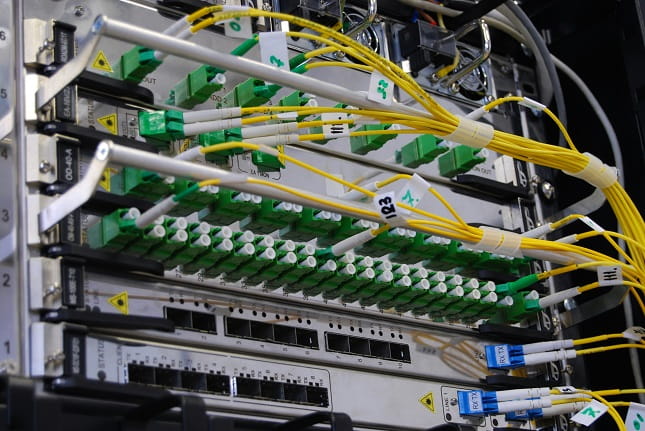
The optical communications industry is entering a period of rapid diversification. While the spotlight often falls on high-speed optical modules powering AI clusters and cloud data centers, a large portion of the market continues to rely on lower-speed optical connectivity for access networks, industrial communications, and enterprise infrastructure.
Although these products share the same fundamental purpose—transmitting data through optical links—their design priorities can be dramatically different. This is especially true when selecting the Optical Module Controller responsible for monitoring, management, and system operation.
As optical communication applications become increasingly specialized, the MCU for Optical Modules is no longer a one-size-fits-all component. High-speed and low-speed modules require different balances of performance, power consumption, integration, and cost.
Architectural Divergence: High-Speed vs. Low-Speed Application Environments
To understand the internal silicon choices of an optical module controller, one must first look at where these devices are deployed.
High-Speed Modules: The Core of Data Centers and AI Clusters
High-speed optical modules (typically scaling from 400G and 800G up to next-generation terabit speeds) operate predominantly within AI data centers, cloud infrastructure, and core telecom backbones. These environments process dense, parallel streams of computing data where any localized latency bottlenecks can stall massive AI training models. These modules manage cutting-edge architectures like high-speed pluggable optics, silicon photonics, and co-packaged optics (CPO).
Low-Speed Modules: Access Networks and Industrial Links
Conversely, low-speed optical modules populate access networks, fiber-to-the-home (FTTH) infrastructure, and industrial optical communications. In these environments, raw data velocity is secondary to coverage, continuous deployment stability, and extreme cost boundaries. The networks rely on predictable, established data loops where equipment must run reliably for years without maintenance, often under harsh environmental conditions.
The Core Role of an MCU for Optical Modules
Regardless of transmission speed, an MCU serves as the intelligent brain of the optical assembly. It operates behind the scenes to ensure signal integrity across the fiber optic link.
An optical module controller handles several fundamental responsibilities:
l Initialization and Calibration: Managing the laser drivers and limiting amplifiers during start-up.
l Real-Time Monitoring: Tracking internal operating parameters, including voltage, laser bias currents, received optical power, and temperature variations.
l System Management: Handling communication protocols with the host equipment via standard interfaces, enabling diagnostics, and issuing real-time safety alerts if operational boundaries are breached.
While these baseline tasks apply across the board, the specific execution methods split drastically when moving up or down the bandwidth spectrum.
High-Speed Optical Modules: Demanding High Performance and Advanced I/O
As optical modules scale up in bandwidth, the physical margin for error shrinks. High-speed optical communication applications require an entirely different tier of MCU processing capacity for several critical reasons:
Processing Overhead and Advanced Protocols
With rapid data modulation schemes, the digital diagnostics monitor (DDM) must execute tasks with absolute precision. The controller needs substantial computational headroom to run real-time compensation algorithms that balance laser degradation and thermal shifts.
Additionally, modern high-density architectures demand fast bus protocols. Traditional interfaces are being replaced by next-generation standards like I3C, which enable high-bandwidth, low-latency, and high-density communication lines to handle rapid telemetry exchanges within the module.
Dense Analog Integration and Space Optimization
High-speed modules require precise diagnostic monitoring. This demands multiple dedicated analog peripherals integrated directly onto the silicon, including multi-channel analog-to-digital converters (ADCs), digital-to-analog converters (DACs), operational amplifiers (OPAs), and comparators (COMP).
Because modern transceivers must fit into tighter form factors to maximize faceplate density on network switches, there is zero space to spare for external components. The internal controller must be housed in ultra-compact packages, such as 3 × 3 mm formats, to optimize PCB space and support the ongoing trend toward higher integration and miniaturization.
Tailored Market Coverage: The GigaDevice Solution Portfolio
Addressing these diverging market requirements requires a dual-track product portfolio approach. Backed by its comprehensive technology portfolio spanning Flash memory, MCUs, analog devices, and sensors, GigaDevice offers fully self-developed and mass-production-ready solutions with high reliability and flexible customization capabilities for a wide range of optical module applications.
GD32E512 Series: Optimized for High-Speed Systems
Targeting the demanding requirements of high-speed optical modules, the GigaDevice GD32E512 series features a high-performance Arm Cortex®-M33 core operating at up to 120 MHz. The series introduces integrated I3C support, enabling high-bandwidth, low-latency, and high-density communication. To further simplify system design and optimize PCB space, it integrates a rich set of application-oriented peripherals—including 3× I²C, 1× MDIO, 2× ADC, 4× DAC, 2× comparators (COMP), and 2× operational amplifiers (OPA)—all within an ultra-compact 3 × 3 mm package.
GD32E252 Series: Designed for Low-Speed Infrastructure
The GigaDevice GD32E252 series is specifically designed for low-speed optical module applications and is built around the efficient Arm Cortex®-M23 core. Through continuous optimization, the series delivers enhanced analog performance while maintaining low power consumption and reliable operation. Built to address the requirements of cost-sensitive applications, these devices feature compact package options, wide-temperature operation, and strong EMC performance, helping customers simplify designs and reduce development complexity.
Summary
The continuous growth of AI computing, cloud services, and high-speed networking infrastructure makes choosing the right optical module controller a critical architectural decision. High-speed environments require high processing headroom, advanced communication protocols, and dense peripheral integration to manage the transition to next-generation high-speed networks. Meanwhile, low-speed setups depend on optimized power efficiency, compact integration, and robust environmental protection to scale reliably across mass deployments. Having access to tailored product paths allows network architects to build balanced, high-reliability infrastructure ready for tomorrow’s data demands.