






























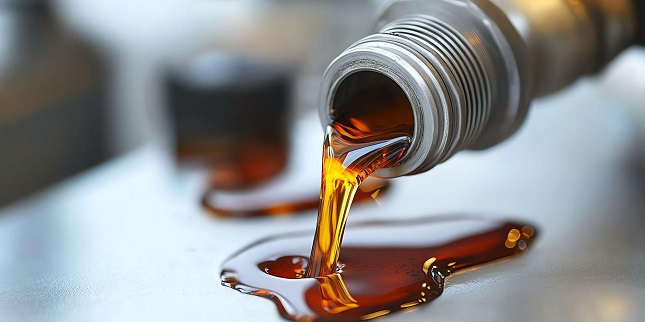
When two surfaces in contact move in relative motion to each other, it leads to friction and wear. Friction can generate heat, which accelerates wear of the moving surfaces. To extend the useful life of the moving parts, it is important to control friction. Lubricants are materials that reduce friction and wear between two moving surfaces. Lubricants can be solid/dry, semi-solid, liquid or gas.
Dry lubricants are solids that, when applied between two moving surfaces, can reduce friction and wear and prevent damage to the surfaces. Solid lubricants can be used in the form of powders, dispersed particles or coated films. Common dry lubricants are inorganic compounds like Hexagonal Boron Nitride (hBN), Molybdenum Disulfide (MoS2) and Tungsten Disulfide (WS2).
Dry lubricants are also available as dry lube, where they are mixed with a liquid carrier like alcohol, water, or wax and sold in sprayable forms. It can be applied as a liquid, but the liquid carrier evaporates off, leaving a dry, non-sticky coating of the lubricant. Once you apply dry lube, you have to allow it to dry before using the equipment.
The dry lube is best for dry and sunny conditions and does not attract dust or dirt. It can be used in dusty environments as it does not attract dust, which can lead to abrasion. It can be used for lubricating hinges, locks, bicycle chains, gears and more. You can buy dry lube online based on your specific requirements. All dry lubes have a waxy consistency at ambient temperatures and have a low viscosity; therefore, they can be applied easily to the surface to be lubricated.
Uses
- Dry lubricants are preferred where the lubricating film cannot be formed using oils and grease.
- They are preferred where the semi-solid lubricant, like greases, cannot be used due to high temperature or high load. Dry lubricants can work effectively over a wide temperature range.
- They are preferred where the atmosphere contains dust particles in large numbers. Oils and greases tend to pick up dirt and are unsuitable.
- Dry lubricants can be added to oils and greases to enhance their lubricating and load-carrying properties. They can be used with binders to make them stick to the moving surfaces.
- Dry lubricants are preferred when cleanliness has to be maintained in the work environment. Workers are at a low health risk due to the absence of vapours.
Dry lubricants
Hexagonal Boron Nitride (hBN)
It is one of the most stable forms of Boron Nitride (BN) and is white in colour. It can provide effective lubrication at both low and high temperatures. It exhibits a low coefficient of friction due to its lamellar crystal structure. It has a structure similar to that of Graphite and is also known as ‘White Graphite’.
In its crystal structure, within each layer, alternating Boron and Nitrogen atoms are arranged in a honeycomb lattice. The atoms within the layers are bonded with covalent bonds, while the different layers are connected by weak Van der Waals forces. When a shear force is applied, the layers slide against each other, resulting in a low coefficient of friction.
hBN has properties like high thermal conductivity, electrical insulation, oxidation resistance, chemical inertness and corrosion resistance.
Molybdenum Disulfide (MoS2)
It is classified as a Transition Metal Dichalcogenide (TMD) and occurs naturally as an ore, Molybdenite and Jordisite. It shows excellent lubricating properties due to its layered structure. In a layer, a plane of Molybdenum atoms is sandwiched between two planes of Sulphur atoms, forming a S-Mo-S structure. The bonds within a layer are covalent, whereas the layers are connected by weak Van der Waals forces. The easy shearing of the layers leads to a low coefficient of friction.
It can provide effective lubrication up to a temperature of 350 °C in an oxidising environment and up to 1100 °C in non-oxidising atmospheres.
Tungsten Disulfide (WS2)
It is a compound made up of Tungsten and Sulphur and is classified as a Transition Metal Dichalcogenide (TMD). It is found as a mineral ore, Tungstenite. It has an extremely low coefficient of friction due to its layered lattice structure.
In a layer, a plane of W atoms is sandwiched between two layers of S atoms, forming an S-W-S structure. Within the layers, the bonds are covalent, while the adjacent layers are held together by weak Van Der Waals forces. The low adhesion between the layers allows them to shear easily, leading to a low coefficient of friction.
WS2 can be used for lubrication in high temperature, vacuum, high pressure and high load conditions.