



























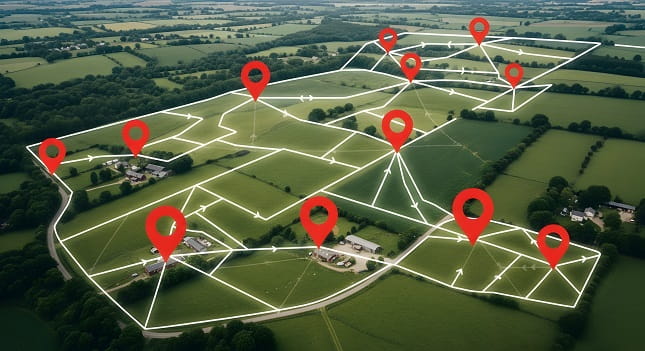
The architecture, engineering, and construction (AEC) industry has undergone a digital transformation in how it captures and utilizes project data. Modern surveying and mapping now create comprehensive digital representations of the physical world. For firms seeking a competitive advantage, effectively leveraging this data is the key to superior client service. This article explores how to translate advanced survey and mapping data into enhanced value for your clients.
The Evolution of Data Collection Technologies
Modern surveying has shifted from taking single measurements to capturing millions of data points per second. Today’s total stations and GNSS-integrated systems deliver real-time accuracy that was unimaginable a decade ago.
Global Navigation Satellite Systems (GNSS) include networks like GPS that enable precise positioning anywhere on Earth. For clients, this means faster project starts, less time in the field, and richer datasets that support every phase of development.
Utilizing an advanced survey & mapping solution can turn this raw data into a competitive advantage using enterprise-grade cloud analytics and AI-driven algorithms. This gives survey firms a fast, easy way to visualize, analyze, and manage the intelligence that drives better client service without the overhead costs of IT development and maintenance.
Control Networks and Geodetic Precision
For organizations planning business expansion, geodetic surveying provides this backbone through the creation of precise control networks that anchor all subsequent data to absolute positions on the Earth’s surface. These networks, marked by permanent geodetic markers, ensure that every piece of information collected, whether from ground surveys, drones, or satellites, aligns perfectly within a common coordinate system.
Mapping control is particularly critical for large-scale civil engineering work and infrastructure projects that span significant distances. Route surveys for highways, railways, and pipelines depend entirely on this geodetic framework to maintain alignment accuracy over hundreds of kilometers.
When clients understand that their project is built upon a verified control network, confidence in the outcome increases dramatically. The precision of geodetic networks eliminates the cumulative errors that historically plagued linear infrastructure projects, saving millions in potential rework.
Integrating Multiple Data Sources
The true power of contemporary survey and mapping solutions lies in their ability to fuse information from diverse collection methods into unified, actionable intelligence. Aerial mapping using drones captures wide-area context and orthorectified aerial imagery that reveals patterns invisible from the ground.
Meanwhile, satellite imagery provides temporal data showing how sites change over seasons or years. These remote observations are validated and enhanced by detailed ground surveys that capture subtle grade changes, vegetation density, and existing infrastructure with millimeter precision.
Hydrographic surveying adds the underwater dimension for coastal or riparian projects, while subsurface utility engineering employs geophysical methods to locate buried assets before excavation begins. The synthesis of these inputs within geographical information systems enables sophisticated spatial data analysis.
From Point Clouds to Digital Twins
The raw output of modern surveying and mapping operations is point cloud data, dense collections of three-dimensional measurements representing every surface scanned. While incredibly valuable, this data requires processing and visualization to become useful for decision-makers.
Advanced geospatial mapping platforms transform these millions of points into intelligent models that non-specialists can explore and interrogate. This capability enables 3D facilitated coordinated planning around sensitive elements, such as heritage infrastructure, existing vegetation, and preliminary design concepts.
Hosting data in the cloud makes complex 3D models accessible to everyone, anywhere. Archaeologists, architects, and engineers can open a browser on their phone or laptop to view the data without expensive software or training.
Boundary Surveys and Property Rights
While technological advancement captures headlines, the legal dimensions of surveying and mapping remain fundamental to client protection and project success. Cadastral surveys and boundary surveys establish the definitive locations of property lines, placing boundary monuments that physically mark legal divisions on the ground.
These determinations are governed by surveying law, a complex body of statutes and case law that varies between jurisdictions and requires specialized expertise to navigate. For land development projects, the accuracy of these boundary determinations directly affects property values, development potential, and neighbor relations.
Land surveyors performing land surveying services must understand the legal principles of evidence, adverse possession, and easement creation. When clients receive certified boundary surveys, they gain legal protection for their investments and clarity for future transactions.
The Bottom Line
Advanced surveying and mapping transforms client service by eliminating unknowns and accelerating timelines. Investing in comprehensive geospatial mapping upfront prevents budget overruns and delays. Data collected during planning retains value for decades, supporting predictive maintenance and digital twins. This approach positions surveyors as strategic advisors rather than transactional vendors. Turning complex spatial data into clear, collaborative intelligence defines exceptional client service in an era of rapid digital transformation.