




























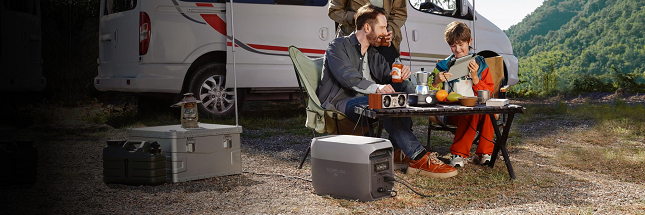
A weekend campsite does not need endless electricity, but it does need the right power station. The wrong pick adds weight, wastes battery, or leaves you rationing basic gear by Saturday night.
EcoFlow and Jackery both sell battery systems for camping, road trips, and off-grid stays. Both brands cover a wide range, from compact power station picks for lights and phones to larger models that can handle coolers, cook gear, and backup use.
The better buy depends less on brand loyalty and more on how you camp. For most weekend users, the real question is simple: do you want the easiest setup, or more flexibility once your gear list grows?
Start with your real weekend load
Most campers do not need to size around a dramatic emergency scenario. They need a power station with enough stored energy for lighting, phones, cameras, a fan, maybe a small cooler, and a few comfort items that turn a basic camp into a relaxed one.
Small electronics are the easy part
Both brands cover the low end well. EcoFlow says its portable units can support camping, RV trips, and emergency backup, while Jackery markets camping models around phones, drones, lights, and other small outdoor gear, so a small power station is rarely hard to find.
Coffee, coolers, and heated comfort change the math
The comparison gets more serious once you add appliances with sustained draw. A weekend trip with an electric cooler, coffee maker, or heated blanket moves you out of the “just charge devices” category and into true battery planning.
Output matters as much as battery size
A power station with a larger battery still does not help if the inverter cannot start or sustain the appliance you packed. That is why weekend buyers should read watt-hours and rated output together, not as separate marketing bullets.
Recharging on the road can decide the trip
For Friday-to-Sunday camping, recharge speed matters almost as much as stored capacity. A unit that can top up quickly from AC, solar, or the vehicle may cover a lighter battery plan and reduce the need to overspend.
Where EcoFlow starts to pull ahead
EcoFlow’s lineup feels broader for campers who expect their setup to grow. The brand positions its portable systems for camping, RV trips, DIY use, and home backup, which usually leads to more options once your weekend kit becomes a bigger multi-use purchase.
That flexibility shows up in power station options from compact RIVER models to heavier DELTA units. On the current U.S. site, EcoFlow frames the category around camping, RV travel, workstations, emergencies, and home backup.
In the current 1kWh class, the DELTA 3 Plus is listed at 1024Wh and 1800W output. EcoFlow also lists five recharge methods, up to 1000W solar input, sub-10ms UPS support, and 30 dB operation under lighter loads.
Why Jackery still has a real case
Jackery remains easy to recommend for campers who value a simpler brand story. Its site still speaks directly to camping, outdoor use, and weekend gear, which makes product selection feel straightforward for buyers who do not want to decode a larger ecosystem.
The brand identity is clear
Jackery’s camping collection is built around outdoor essentials, and that focus helps first-time buyers. If your main use case is tent camping, road trips, or a short RV stop, the shopping path may feel easier than on a site that also pushes home backup.
The 1kWh class still looks competitive
Jackery’s Explorer 1000 v2 is listed at 1070Wh, 1500W rated output, LiFePO4 chemistry, about 23.8 pounds, and dual DC inputs up to 400W. Jackery also says it can recharge from zero to full in about one hour in its fast-charge mode.
Simplicity can beat feature depth
That profile is still appealing. Many weekend campers do not need UPS behavior, app-heavy energy management, or higher solar intake. They need a box that is easy to carry, quick to understand, and sized well for a cooler, lights, and personal devices.
What the numbers mean at camp
Spec sheets are useful, but camping exposes the difference between headline specs and actual convenience. A weekend buyer should care about three things first: how much they can run at once, how quickly they can refill, and whether the unit fits the way they travel.
| Model | Capacity | Rated Output | Recharge Notes | Camping Read |
|---|---|---|---|---|
| EcoFlow DELTA 3 Plus | 1024Wh | 1800W | 1500W AC input, five recharge methods, up to 1000W solar input | Better if your load may expand |
| Jackery Explorer 1000 v2 | 1070Wh | 1500W | About 1.58-hour AC charging, up to 400W solar input | Better if you want a simple 1kWh class pick |
For cooking and higher-wattage gear
EcoFlow has the edge if your weekend setup may include more demanding appliances. A higher rated output in the 1kWh class gives you more headroom for quick-use kitchen gear, hair tools at camp cabins, or other loads that sit beyond basic electronics.
For lighter kits and cleaner buying decisions
Jackery makes sense when your list stays modest and predictable. If you mostly need cold storage, lights, camera charging, and maybe a fan, its 1kWh option still covers a lot without pulling you toward a broader system strategy.
For mixed home and camping use
This is where EcoFlow looks stronger. The DELTA 3 Plus is positioned not only for outdoor trips but also for home backup, and third-party testing from TechRadar currently ranks it as the best overall portable power station for most users.
A simple weekend buying checklist
If you are choosing between these brands for camping, buy for your second trip, not your first. Weekend kits tend to grow once people add a better cooler, more lights, a projector, an induction plate, or a second traveler with more devices.
- List the appliances you will actually run, not the ones you might buy later.
- Check rated output before capacity, especially for cook gear and heated items.
- Decide whether fast solar input or faster wall charging matters more for your trips.
A fuel generator still has a place for long off-grid use, but it brings noise, fuel planning, and carbon monoxide risk. The EPA says portable generators should never run inside a home or garage and must stay outside, away from openings.
The better fit for most campers
For a pure weekend camping buyer, Jackery still earns a fair look because the brand stays focused and easy to shop. If your needs are modest, its current 1kWh class option remains practical and competitive.
EcoFlow is the better pick if you want more room to grow, faster charging flexibility, and a unit that can move between campground duty and home backup without feeling like a single-purpose purchase.